
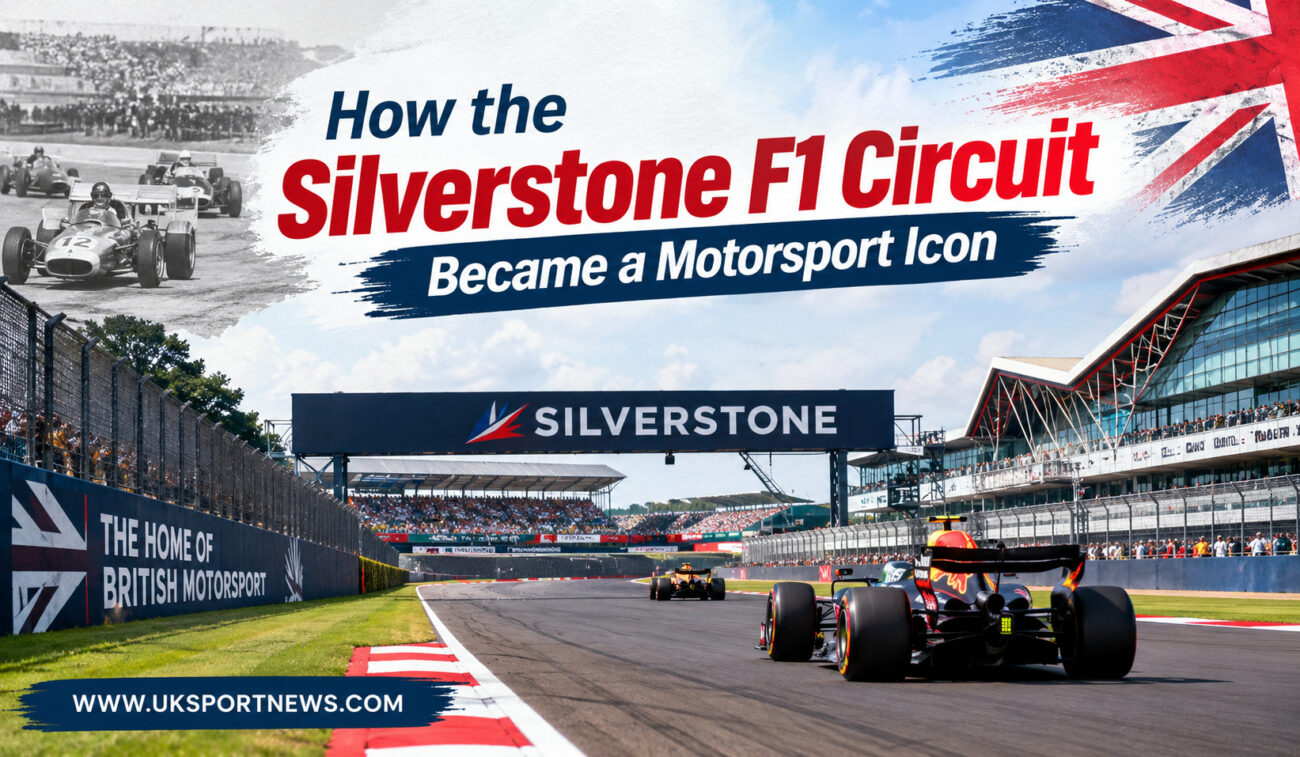
On 2 October 1948, roughly 100,000 people showed up to watch cars race around a converted bomber base in Northamptonshire. That race made the Silverstone F1 circuit the birthplace of British motor racing, and nearly eight decades later it’s still one of the sport’s crown jewels. Here’s how a wartime airfield turned into the track drivers still call the toughest test on the calendar.
From Bomber Base to Racetrack
Silverstone wasn’t built to be a racetrack. It started life in 1943 as RAF Silverstone, a station that trained Wellington bomber pilots for night missions. When the war ended, Britain had plenty of spare airfields and almost no working race circuits, since Brooklands had been swallowed by aircraft development and Donington Park was still buried under wartime storage.
The Royal Automobile Club took a one-year lease on the site in early 1948 and got to work. There wasn’t much of a budget. Straw bales, ropes, and oil drums marked the racing line where fighter planes used to taxi.
That first race, the RAC International Grand Prix, drew an estimated 100,000 spectators and was won by Luigi Villoresi in a Maserati. It wasn’t glamorous, but it worked.
The Birth of a World Championship
Two years later, Silverstone hosted something bigger. On 13 May 1950, it staged the very first round of the newly created Formula One World Championship, and King George VI and Queen Elizabeth watched from the royal box. It remains the only time a reigning monarch has attended a British motor race.
Giuseppe Farina won that day in an Alfa Romeo. What makes the result matter beyond the trophy is longevity: Silverstone is one of only four circuits from that inaugural 1950 season still on the F1 calendar today, alongside Monaco, Spa, and Monza.
That’s not a small thing in a sport that has torn up and rebuilt half its old venues.
The Silverstone Shuffle
For decades, Silverstone didn’t have the British Grand Prix all to itself. From 1955 to 1986, the race rotated between Silverstone, Aintree, and Brands Hatch, moving fan bases and logistics around the country year after year.
That changed in 1987, when Silverstone locked in the race permanently. Since then, every British Grand Prix has been run on this one circuit, and the BRDC (British Racing Drivers’ Club) has owned and run the show, having bought the full 720-acre estate from the Ministry of Defence back in 1971.
The Corner Sequence That Built a Reputation
Ask a current F1 driver what makes Silverstone special and most of them won’t mention the history. They’ll talk about Maggotts, Becketts, and Chapel.
This is a flowing left-right-left-right-left sequence of corners taken at close to 300 km/h, and it’s widely considered one of the toughest corner combinations in world motorsport. Copse, the fast right-hander that leads into it, isn’t much easier. Both corner names have odd origins:
- Copse is named for its closeness to Chapel Copse and Cheese Copse, patches of nearby woodland.
- Maggotts takes its name from neighboring Maggot Moor, though nobody’s fully sure why the spelling changed.
- Becketts and Chapel are named after the medieval chapel of St Thomas à Becket, which was pulled down in 1943 to make room for the airfield.
Corners named after farmland and a demolished chapel now define one of the fastest, most technical sequences in Formula 1. That’s Silverstone in a nutshell: history hiding inside the racing line.
Chaos, a Near-Miss, and a Contract Crisis
Silverstone hasn’t always felt secure on the calendar. The 1973 race produced what was, at the time, the biggest crash in F1 history, when Jody Scheckter spun at Woodcote on the opening lap and triggered a pile-up that collected most of the field. Andrea de Adamich suffered injuries serious enough to end his career.
Safety work followed for years afterward, including a rebuilt Abbey chicane finished in just 19 days before the 1994 race.
The bigger crisis came later. In 2008, organizers announced the British Grand Prix would move to Donington Park from 2010, on a 17-year deal. Donington’s owners couldn’t raise the £135 million needed to redevelop the site, and the company collapsed into administration by late 2009. With no other venue ready, Formula One handed the race back to Silverstone that December, this time on a new 17-year agreement.
The Wing Changes Everything
Part of that 2009 deal required a serious rebuild. Silverstone added a new “Arena” section of track and, for 2011, opened The Wing, a new pit and paddock complex at Club corner. The start-finish line moved from its old spot near Woodcote and Copse to sit between Club and Abbey instead, and the old Bridge section of track was decommissioned for good.
The result is the layout drivers race today: the Arena Grand Prix Circuit, 5.891 km with 18 corners. Max Verstappen holds the outright lap record there, a 1:27.097 set in a Red Bull RB16 during the 2020 70th Anniversary Grand Prix.
Records, Rivalries, and Record Crowds
Silverstone’s modern era has been just as eventful as its early one. In 2021, Lewis Hamilton and Max Verstappen collided at Copse on the opening lap, sending Verstappen into a 51G impact and sparking one of the sport’s sharpest rivalries. Hamilton went on to win after passing Charles Leclerc late in the race.
The crowds keep growing too. The 2022 event drew over 400,000 fans across the weekend, a record at the time. Then 2023 broke it again, with 480,000 fans attending across the weekend, plus more than 60,000 camping nearby.
Hamilton’s own numbers at the venue are hard to argue with. He won the 2024 British Grand Prix for his ninth victory at Silverstone, the most wins any driver has managed at a single circuit in F1 history, and it came 945 days and 56 races after his previous win. In February 2024, Formula 1 and the BRDC locked the race in through 2034, keeping Silverstone on the calendar into its ninth decade of Grand Prix racing.
Key Takeaways
- First British Grand Prix: 2 October 1948, roughly 100,000 spectators.
- First F1 World Championship round: 13 May 1950, won by Giuseppe Farina.
- Founding circuit: One of four venues from the 1950 season still on the calendar.
- Signature corners: The Maggotts-Becketts-Chapel sequence, taken at near 300 km/h.
- Current layout: 5.891 km, 18 corners, in use since 2011.
- Most wins at the circuit: Lewis Hamilton, with nine.
- Contract security: Confirmed on the F1 calendar through 2034.
FAQs
When did Silverstone host its first race?
Silverstone held its first Grand Prix on 2 October 1948, on a converted RAF airfield.
Why is Silverstone considered so important to F1 history?
It hosted the first-ever round of the Formula One World Championship in 1950 and remains one of only four circuits from that season still racing today.
What is the most famous part of the Silverstone F1 circuit?
The Maggotts, Becketts, and Chapel corner sequence, a fast, flowing set of direction changes drivers consistently rank among the hardest on the calendar.
Who holds the most wins at Silverstone?
Lewis Hamilton, with nine British Grand Prix victories at the circuit.
How long will Silverstone keep hosting the British Grand Prix?
A 2024 agreement between Formula 1 and the BRDC secured Silverstone’s place on the calendar through 2034.
Conclusion
From straw bales on a bomber airfield to a 5.891 km circuit hosting six-figure crowds, the Silverstone F1 circuit has earned its status the hard way, through near-cancellations, rebuilt corners, and some of the sport’s defining moments. It’s not just where Formula 1 started. It’s still where a lot of championships get decided.
