
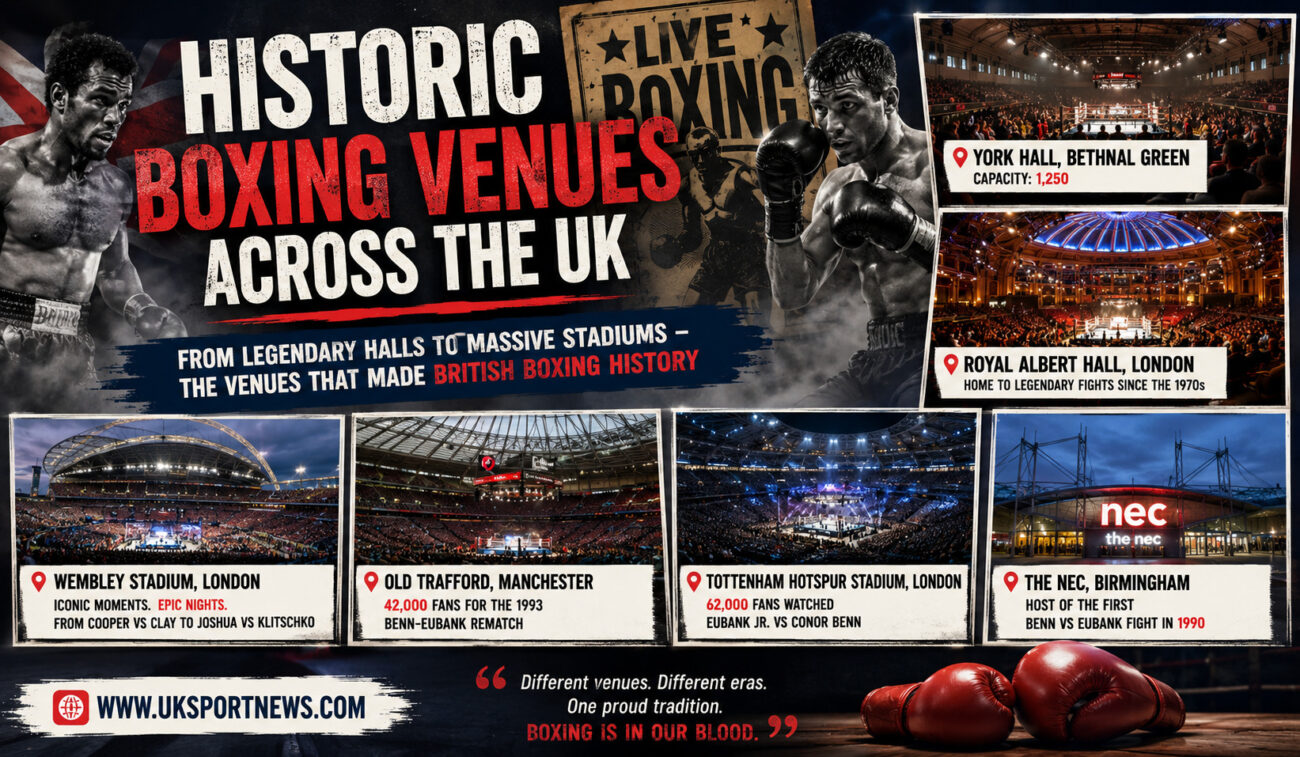
Daniel Mendoza, Britain’s bareknuckle champion from 1792 to 1795, lived just across the road from what’s now Bethnal Green’s York Hall. More than two centuries later, that same patch of East London is still considered the beating heart of British boxing. Historic boxing venues across the UK range from that small, sweat-soaked hall to stadiums packed with 80,000 fans, and each one has shaped the sport in its own way.
York Hall, Bethnal Green
York Hall opened in 1929 and began hosting professional boxing in the late 1940s. With a capacity of just 1,250, it’s tiny compared to modern arenas, but it’s widely regarded as the most iconic venue in British boxing.
Nearly every major British fighter of the last three decades passed through it early in their career. Lennox Lewis, Tyson Fury, Anthony Joshua, Joe Calzaghe, Ricky Hatton, Carl Froch and David Haye all fought there before they became household names.
The Fastest Finish in the Hall’s History
Joe Calzaghe delivered one of the venue’s most memorable moments in 1995, stopping Frank Minton in just 85 seconds. It’s the kind of result York Hall has produced hundreds of times over, mostly for fighters nobody outside the room had heard of yet.
1,250 seats is all York Hall holds, and yet it carries more weight in British boxing folklore than venues ten times its size.
Royal Albert Hall, London
The Royal Albert Hall has hosted boxing for decades, blending sporting contest with the kind of civic occasion only a handful of London venues can manage. It staged the second fight of Alan Minter and Kevin Finnegan’s brutal three-fight trilogy in 1976, a rematch that went the full 15 rounds just like their first bout.
Frank Bruno, one of Britain’s most beloved heavyweight champions, boxed there just once as a professional, winning inside a round against American opponent James Holley in December 1990. It’s a small footnote in a huge career, but it says something about the hall’s status that even a fighter usually showcased at bigger arenas made a stop there.
Wembley
Wembley has been English boxing’s answer to scale for over half a century. The old stadium delivered one of the most replayed moments in British sporting history when Henry Cooper dropped Cassius Clay in 1963, a clip the BBC still returns to decades later.
The rebuilt Wembley Stadium picked up where the old one left off. It hosted Anthony Joshua’s win over Wladimir Klitschko in 2017, a fight most modern British boxing events are still judged against, and it staged the explosive Carl Froch versus George Groves rematch in 2014 in front of 80,000 fans.
A Stage Built for Heavyweight Theater
Wembley’s size makes it suited to exactly one kind of night: a heavyweight main event with genuine crossover appeal, the sort that fills a stadium rather than just an arena.
Old Trafford, Manchester
Best known as a football ground, Old Trafford has also hosted genuinely historic boxing. The Nigel Benn and Chris Eubank rematch in 1993 drew 42,000 fans to the stadium, a crowd that reflected just how much the rivalry had captured the public’s imagination.
42,000 fans at Old Trafford for a single domestic rivalry fight shows how far British boxing’s biggest nights can travel beyond London.
Tottenham Hotspur Stadium, London
One of the newer additions to this list, Tottenham Hotspur Stadium hosted the long-awaited Chris Eubank Jr. versus Conor Benn fight, drawing 62,000 fans to watch the sons of two 1990s rivals settle their own version of the feud. It’s a sign that modern football stadiums have become the default home for boxing’s biggest domestic nights, much as Wembley and Old Trafford once were.
The National Exhibition Centre, Birmingham
The NEC hosted the first Benn versus Eubank fight in November 1990, the bout that launched British boxing’s most famous domestic rivalry. It’s a reminder that not every historic boxing night happened in London or Manchester. Birmingham has its own place in the sport’s story, even if it gets mentioned less often than the bigger stadiums.
Key Takeaways
- York Hall’s capacity: just 1,250 seats, despite being considered British boxing’s spiritual home.
- Royal Albert Hall’s history: hosted the Minter-Finnegan trilogy and Frank Bruno’s only Royal Albert Hall fight.
- Wembley’s biggest nights: Henry Cooper vs. Cassius Clay in 1963 and Joshua vs. Klitschko in 2017.
- Old Trafford’s crowd: 42,000 fans for the 1993 Benn-Eubank rematch.
- Tottenham Hotspur Stadium’s modern role: hosted 62,000 fans for Eubank Jr. vs. Conor Benn.
FAQs
Why is York Hall considered the home of British boxing?
It’s hosted the early careers of nearly every major British fighter of the last three decades, despite holding just 1,250 fans.
What happened at the Royal Albert Hall in 1976?
It hosted the second fight of the Alan Minter and Kevin Finnegan trilogy, which went the full 15 rounds.
What is Wembley’s most famous boxing moment?
Henry Cooper dropping Cassius Clay in 1963, a moment still replayed in British sporting history.
How many fans attended the Benn-Eubank rematch at Old Trafford?
42,000 fans in 1993.
Where was the first Benn vs. Eubank fight held?
At the National Exhibition Centre in Birmingham, in November 1990.
Conclusion
From York Hall’s cramped, historic ring to Wembley’s 80,000-seat stage, historic boxing venues across the UK show just how many different shapes a great fight night can take. Some of the sport’s biggest names started in rooms that held barely a thousand fans, and ended up filling stadiums built for entirely different sports.
