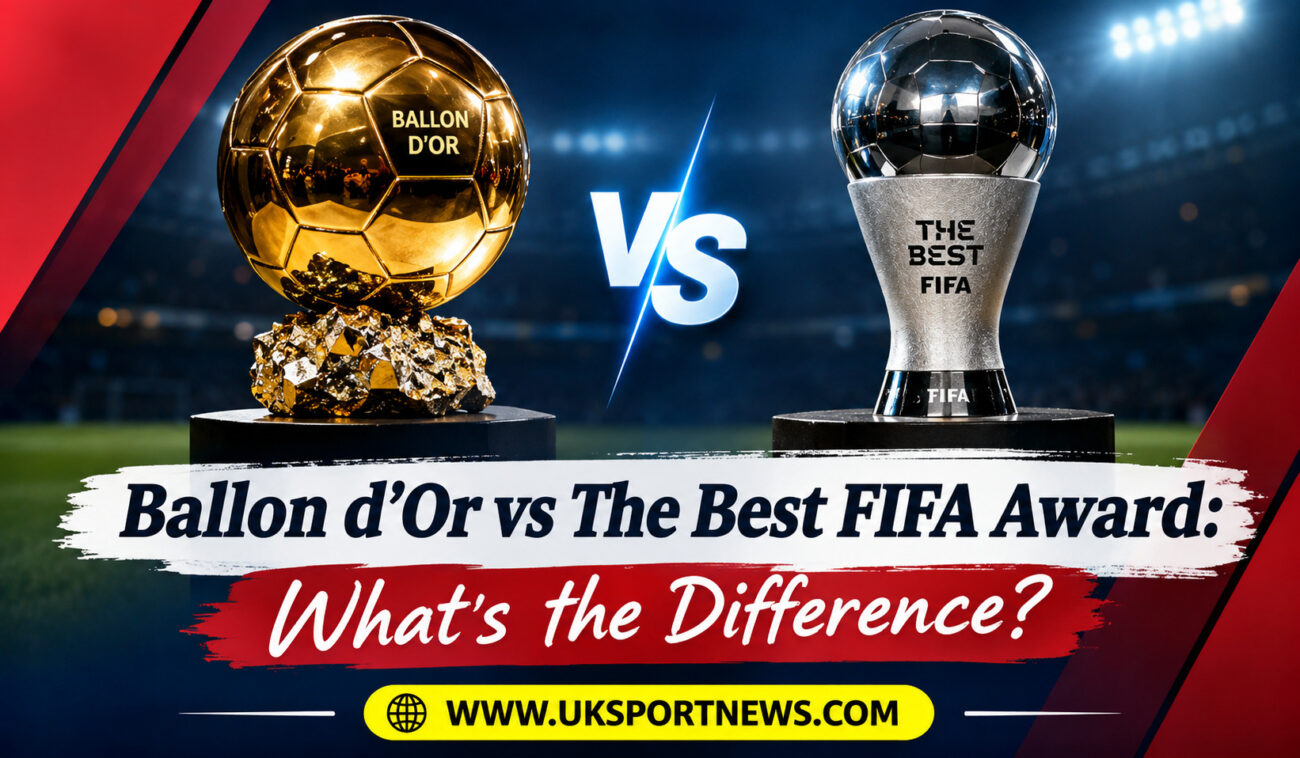
Ousmane Dembélé won both major individual awards for 2025, so the two trophies looked identical for once. Then Harry Kane won the Ballon d’Or in 2026, and the debate came back. Fans often ask how Ballon d’Or vs The Best FIFA actually differs. The two prizes sound alike, yet they have different owners, voters, and rules.
This guide explains each award in plain English. You’ll see who created them, who votes, and how the results can split. By the end, you’ll know exactly why two “best player” trophies exist.
Ballon d’Or vs The Best FIFA: The Short Answer
The Ballon d’Or comes from France Football, and it started in 1956. The Best FIFA Football Awards come from FIFA, and they began as a separate prize in 2016. Both name a men’s and a women’s player of the year. However, they use different voting groups and different time windows.
Put simply, the Ballon d’Or leans on journalists, while The Best asks four groups to vote. Those groups are national team coaches, national team captains, journalists, and fans. Because of that difference, the two awards don’t always agree. Over the years, the split has been a regular source of debate.
Where the Ballon d’Or Comes From
France Football launched the award in 1956, and Stanley Matthews won the first one. The magazine is owned by the L’Équipe Group, and UEFA has co-organised the event since 2024. The 70th edition took place at the London Palladium on 26 October 2026. For a full breakdown of that night, see our explainer on Ballon d’Or 2026.
Journalists from the top 100 FIFA-ranked countries vote for the men’s award. Each one ranks ten players, and points decide the winner. The women’s award uses the top 50 nations. Nobody outside the press panel gets a ballot, which makes the Ballon d’Or a journalist-led prize.
Where The Best FIFA Award Comes From
FIFA had its own World Player of the Year award from 1991. Then from 2010 to 2015, FIFA and France Football joined forces for a combined FIFA Ballon d’Or. That partnership ended, and each body returned to its own award. The Best FIFA Football Awards started in 2016 as FIFA’s standalone prize.
The Best uses a larger and more varied voting group. Coaches and captains of national teams vote, along with journalists and fans on FIFA’s website. Each of those four groups carries 25% of the total. As a result, a fan’s vote counts the same as a captain’s vote in the final tally.
How the Voting Systems Compare
Here’s a simple side-by-side view of the main rules.
- Owner: The Ballon d’Or belongs to France Football, and The Best belongs to FIFA.
- Started: The Ballon d’Or began in 1956, and The Best began in 2016.
- Voters: The Ballon d’Or uses journalists, while The Best uses coaches, captains, journalists, and fans.
- Ballot: Ballon d’Or voters rank ten players, while The Best voters pick their top three.
- Weighting: The Best gives each voting group 25%.
What the Ballot Size Means
A ten-player ballot lets a Ballon d’Or voter reward depth. Someone can reward a strong supporting player in ninth or tenth place. A top-three ballot is tighter, so the leading names tend to take most of the points. That structural gap can shift results in close years.
The Role of Fans
Fans have a real voice in The Best, which makes it more of a popularity-minded award. That can be a strength, since fans watch many matches. Still, it also means a player with a huge following can gain an edge. In contrast, the Ballon d’Or keeps its panel smaller and more expert-focused.
The Time Windows Don’t Match
The two awards don’t always look at the same stretch of football. The Best’s 2025 edition covered 11 August 2024 to 2 August 2025. In contrast, the 2026 Ballon d’Or covered the 2025–26 season, including the 2026 World Cup. So the two prizes can judge different parts of a player’s year.
This matters most in World Cup and European Championship years. A big summer tournament might fall inside one award’s window and outside the other. Because of that, a player can lead one race and trail in the other. It’s one of the less obvious reasons the results split.
When the Two Awards Disagreed
Since the split in 2016, the awards have gone to different players in a few years. In 2021, Messi won the Ballon d’Or while Robert Lewandowski won The Best. In 2022, Karim Benzema took the Ballon d’Or and Messi won The Best. In 2024, Rodri won the Ballon d’Or, and Vinícius Júnior won The Best.
Those splits sparked plenty of debate. Some fans argued that journalists had judged more fairly. Others said fan and captain voting gave a more complete picture. Neither side can be proven right, because the award criteria aren’t identical. That’s what makes the comparison fun.
The two awards agreed in several other years. Cristiano Ronaldo won both in 2016 and 2017, and Luka Modrić won both in 2018. Messi won both in 2019 and 2023. In 2025, Dembélé won both, so the same player topped each ballot.
For a complete record of Ballon d’Or champions, check our Ballon d’Or winners list. If you want the British angle, read about English players who won the Ballon d’Or.
The Other Prizes on Each Night
Both ceremonies hand out far more than one trophy. The Ballon d’Or night includes the Yashin Trophy for goalkeepers and the Kopa Trophy for young players. Awards for the best coach, goalscorer, and club also appear. The women’s side gets its own Ballon d’Or as well.
The Best has its own extras. FIFA hands out the Puskás Award and the Marta Award for the best goals in men’s and women’s football. There’s also a fan award, plus honours for coaches and goalkeepers. In 2025, Luis Enrique won the men’s coach award, and Gianluigi Donnarumma won the men’s goalkeeper award.
Common Myths About the Two Awards
One myth says the awards are the same thing with different logos. That’s not true, as the voting groups and rules show. Another myth says FIFA’s award replaced the Ballon d’Or. In fact, the Ballon d’Or kept going, and FIFA returned to its own prize after the 2015 merger ended.
A third myth says fans pick the Ballon d’Or winner. They don’t, because the panel is made up of journalists. Fans do vote for The Best, but their share is capped at 25%. Because of these differences, it’s best to read each result on its own terms.
Which Award Carries More Weight?
Most fans and media treat the Ballon d’Or as the more famous prize. It has a longer history, and its trophy is instantly recognisable. Players often mention it as a career goal. Meanwhile, The Best has the backing of FIFA, which gives it official standing.
Still, neither award is “more correct” than the other. They measure slightly different things, and they ask different people. A fair view is to treat the two as separate honours. When both name the same player, as with Dembélé in 2025, the case for that player looks very strong.
Key Takeaways
- Ballon d’Or: Created by France Football in 1956, with journalists voting.
- The Best FIFA: Created by FIFA in 2016, with coaches, captains, journalists, and fans voting.
- Weighting: Each of The Best’s four groups carries 25%.
- Ballot: Ballon d’Or voters rank ten players, while The Best voters choose three.
- Recent split years: The winners differed in 2021, 2022, and 2024.
FAQs
What is the main difference between the Ballon d’Or and The Best FIFA award?
The Ballon d’Or is voted on by journalists, while The Best also counts coaches, captains, and fans.
Who runs the Ballon d’Or?
France Football runs it, and UEFA has co-organised the event since 2024.
Can fans vote for The Best FIFA Men’s Player?
Yes, fans registered on FIFA’s website make up 25% of the vote.
Did Dembélé win both awards in 2025?
Yes, Ousmane Dembélé won both the Ballon d’Or and The Best FIFA Men’s Player in 2025.
Are the two awards ever the same?
Yes, the winners matched in several years, including 2016, 2017, 2018, 2019, 2023, and 2025.
Conclusion
The Ballon d’Or vs The Best FIFA debate comes down to owners, voters, and timing. France Football’s award leans on journalists, while FIFA’s prize blends coaches, captains, journalists, and fans. Both name a men’s champion each year, and sometimes they agree. Knowing the difference helps you read every result with a clearer eye.
