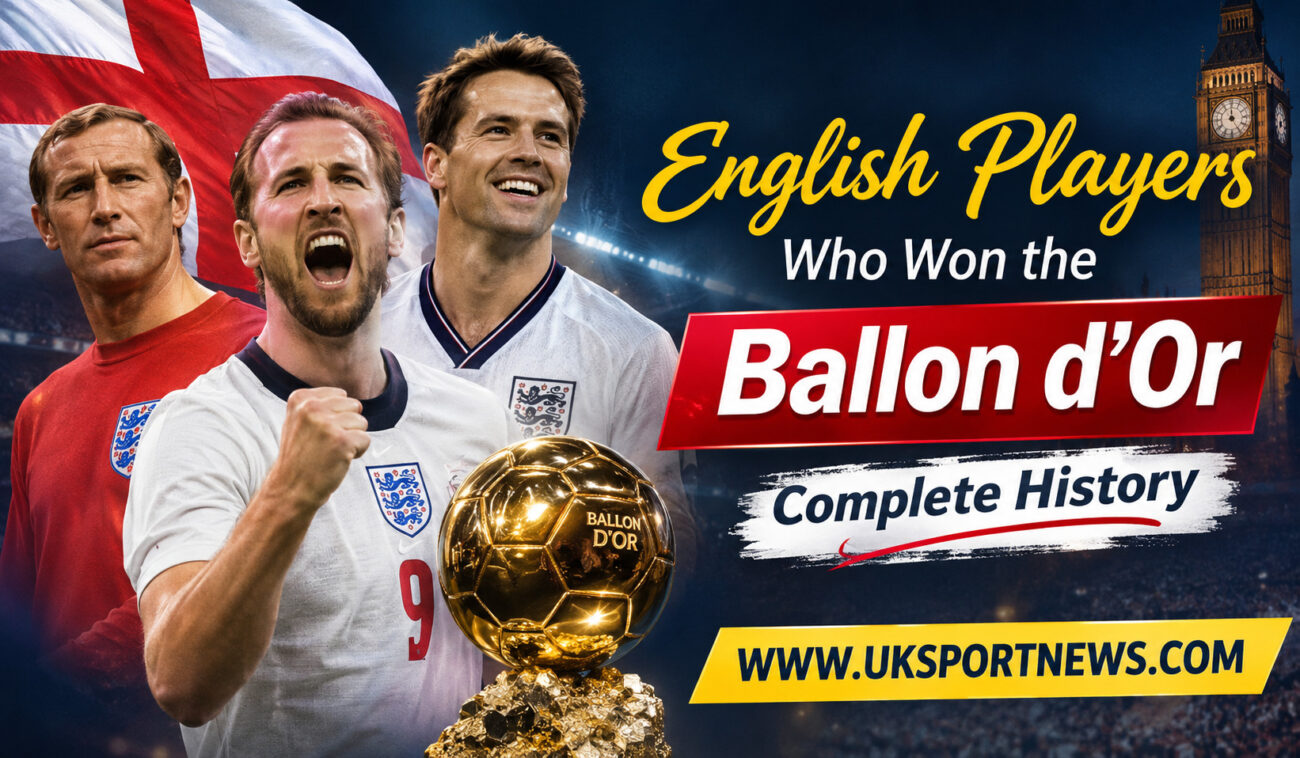
Only five English players have won the Ballon d’Or, and one of them did it twice. That makes six awards across seventy years of the competition. The most recent came on 26 October 2026, when Harry Kane collected the trophy in London. This guide covers every English player who won the Ballon d’Or, with the story behind each win.
The list is short, and the gaps between wins are long. Fans often remember the names but not the seasons that earned them. So here’s a clear walk through each winner, plus the British near-misses and the patterns behind them.
English Players Who Won the Ballon d’Or at a Glance
Here are all six awards in order. Each winner came from a different decade, apart from Keegan’s pair. Notice how long the waits were between the later wins.
- 1956 – Stanley Matthews (Blackpool)
- 1966 – Bobby Charlton (Manchester United)
- 1978 – Kevin Keegan (Hamburg)
- 1979 – Kevin Keegan (Hamburg)
- 2001 – Michael Owen (Liverpool)
- 2026 – Harry Kane (Bayern Munich)
The first and the last share a neat link. Matthews won the very first award in 1956, and the 2026 ceremony in London paid tribute to him. England’s footballing history is, in a sense, bookended by those two nights.
Stanley Matthews: The First Winner in 1956
Matthews was an outside right who played for Blackpool, and he was 41 when he won the first award. That age of 41 still stands out on the record. He earned his place through years of elite wing play. Arguably, voters honoured a career as much as a single season. In that sense, the inaugural prize was a lifetime tribute as well.
His win also set the tone for English football’s place in the story. England had a champion on day one. Because of that, the 2026 decision to host the ceremony in London felt like a proper homecoming. You can read more about that night in our guide to Ballon d’Or 2026.
Bobby Charlton: A World Cup Winner in 1966
Bobby Charlton won the award in 1966, the same year England won the World Cup. He played for Manchester United, and he was a key figure in England’s squad. The World Cup triumph surely helped his case. Charlton’s long-range shooting and calm presence made him a natural pick.
That year also shows how the award mixes club and country. Charlton’s season was strong for Manchester United, yet the World Cup run lifted his case further. In the same period, United teammates Denis Law and George Best also won the award. Law was Scottish, and Best was from Northern Ireland, so the club had a remarkable run of talent.
Kevin Keegan: Back-to-Back Champion in 1978 and 1979
Kevin Keegan is the only Englishman to win the award twice. He did it with Hamburg in West Germany, after leaving Liverpool in 1977. His wins in 1978 and 1979 made him one of the few players to repeat as champion. Hamburg’s success in those years gave voters a clear reason to back him.
It’s worth pausing on how unusual that was. Keegan didn’t win while playing at an English club. Yet he still became a European star through hard running, sharp movement, and steady goals. For many fans, he remains the template for an English player who succeeded abroad.
Michael Owen: The 2001 Winner
Michael Owen won the award in 2001 while playing for Liverpool. That season, Liverpool won the FA Cup, the League Cup, and the UEFA Cup. Owen’s pace and finishing carried him to the top of the voting. He was still in his early twenties, which made the win even more striking.
His victory ended a 22-year wait since Keegan’s second award. For a long time, it was the most recent English success on the list. That’s a big reason fans still talk about Owen’s year, because no one else matched it until Kane arrived. Our full Ballon d’Or winners list shows how his name sits among the all-time greats.
Harry Kane: The 2026 Champion
Kane’s win ended a 25-year wait. He captains England and plays for Bayern Munich, and he is a former Tottenham forward. Match reports credit him with 73 goals for club and country in 2025–26, along with three club trophies. Tottenham celebrated the news on social media and called him “one of our own.”
His win carries a deep symbolic weight. The award came in London, at the first ceremony held in the city, in the 70th edition. As a result, an English winner stepped onto the stage on the night that honoured Matthews. Few could have scripted a better chapter for English football.
What Each English Win Tells Us
Every English win carries a different lesson. Matthews’ award rewarded longevity. Charlton’s came with a World Cup. Keegan’s showed that an English player could shine abroad, and Owen’s proved a young striker could take the prize. Kane’s win combined goals, trophies, and captaincy in one season.
Taken together, the English players who won the Ballon d’Or form a varied group. They played in different positions of the attack, for different clubs, and in very different decades. Even so, one thread links them all. Each one was the clear focal point of a team that won something big.
How English Fans Can Follow the Story
English fans who want the numbers can start with the full Ballon d’Or records. Each winner’s season is easy to look up by year. Because the list is short, you can learn it in an afternoon. That makes it a handy topic for pub debates and quiz nights.
It also helps to know how the vote works. Journalists rank ten players, and points decide the winner. A single brilliant season rarely wins on its own merit unless the team succeeds too. Keep that in mind when you watch the next shortlist form.
British Near-Misses and Related Winners
England isn’t the only British nation on the list. Denis Law won in 1964 as a Scottish player at Manchester United. George Best won in 1968, representing Northern Ireland. Both belong to the same Old Trafford era as Charlton.
Other English players came close without winning. David Beckham finished second in 1999, when Rivaldo took the prize. Close finishes like that show how tough the vote can be. Even a brilliant season doesn’t guarantee a trophy when the rest of the world is playing well.
The German Connection
Two of the six English awards came with German clubs. Keegan won both of his with Hamburg, and Kane won his with Bayern Munich. That’s a striking pattern, and it says something about how English stars can thrive away from home. In both cases, a move abroad gave them a fresh stage and a clear role.
Of course, the pattern is small, and it shouldn’t be pushed too far. Matthews, Charlton, and Owen all won with English clubs. Still, it’s a fun detail for fans who like to spot links across eras.
Why English Wins Are Rare
Several reasons help explain the gaps. English clubs have dominated at different times, but the award often favours attackers who shine in Europe’s biggest games. Meanwhile, Messi and Ronaldo took 11 of the 12 awards between 2008 and 2019. That narrowed the field for everyone else.
The voting panel also matters. Journalists from many countries cast the votes, and they don’t always share a view of English football. For a comparison with a rival award that uses a different system, see Ballon d’Or vs The Best FIFA. That guide shows how a wider voting group can change the result.
Key Takeaways
- Total awards: Five English players have won six Ballon d’Or awards.
- First and latest: Stanley Matthews won in 1956, and Harry Kane won in 2026.
- Double winner: Kevin Keegan won in 1978 and 1979 with Hamburg.
- Gaps: English fans waited 22 years between Keegan and Owen, then 25 years for Kane.
- Near-misses: David Beckham finished second in 1999.
FAQs
How many English players have won the Ballon d’Or?
Five English players have won it, with Keegan winning twice for a total of six awards.
Who was the first English Ballon d’Or winner?
Stanley Matthews won the first Ballon d’Or in 1956.
Which English player won the Ballon d’Or twice?
Kevin Keegan won in 1978 and 1979 while playing for Hamburg.
When did an English player last win before Harry Kane?
Michael Owen won in 2001, which was 25 years before Kane’s win.
Did Harry Kane win the Ballon d’Or in 2026?
Yes, Kane won the men’s award on 26 October 2026 at the London Palladium.
Conclusion
The story of English players who won the Ballon d’Or is short but rich. Matthews, Charlton, Keegan, Owen, and Kane each earned the prize in a different era. Their wins show how rare an English champion is, and how much each one means. With Kane’s 2026 triumph, the list has a fresh chapter and a new reason for hope.
