
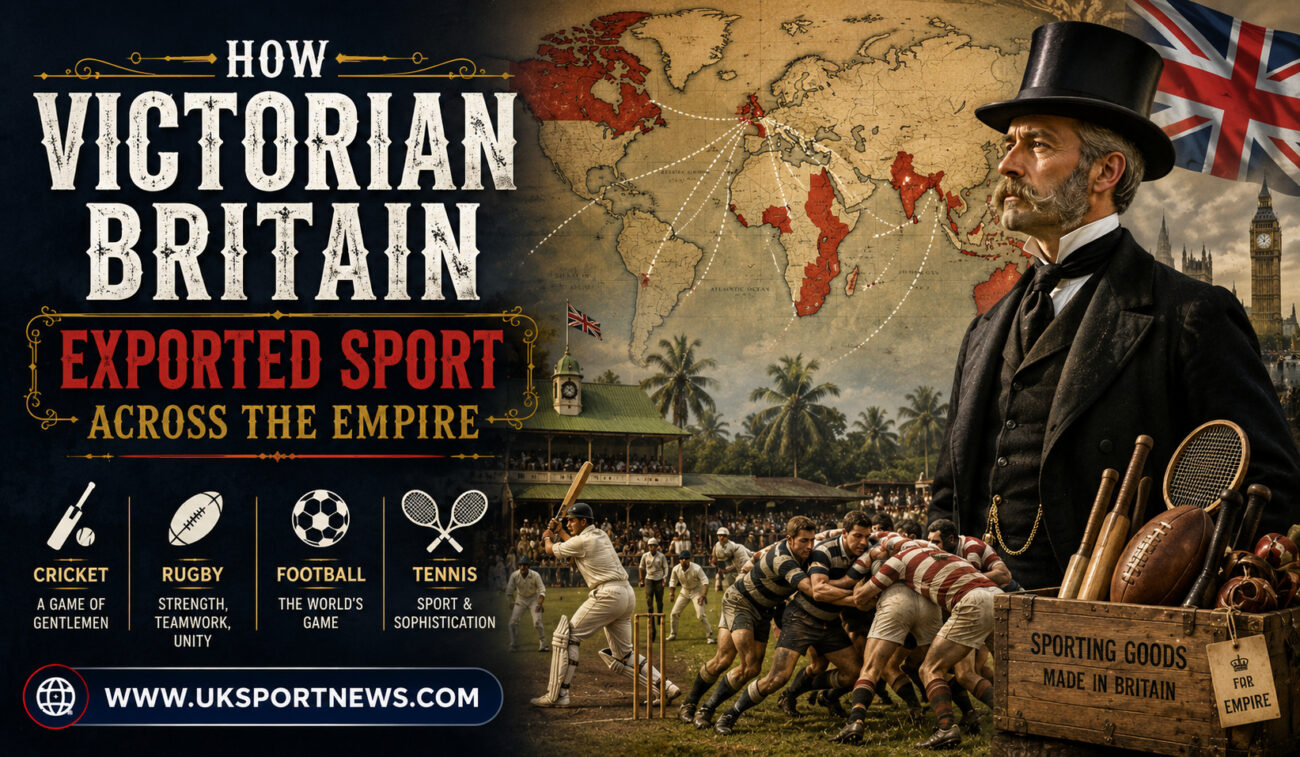
Football’s laws were written down in a London tavern in 1863. Lawn tennis was patented by a British Army major just over a decade later. Cricket, already centuries old by the time Victoria took the throne, was carried to every continent the empire touched by soldiers, missionaries, and railway engineers who packed a bat alongside their kit. Nearly every major sport played worldwide today either originated in Victorian Britain or was standardised there, and the empire’s reach is the main reason those games ended up on every inhabited continent within a single lifetime.
Why Victorian Britain Became a Sporting Export Machine
Britain in the Victorian era had two things very few other countries could combine at that scale: a global network of colonies, garrisons, and trading posts, and a growing obsession with codifying informal folk games into strict, repeatable rules. Public schools such as Rugby, Eton, and Harrow had spent decades turning rough village games into structured sports with written rulebooks, largely as a way of building discipline and character in young men destined for careers running the empire.
Once a sport had a fixed rulebook, it became something that could travel intact. Soldiers, civil servants, engineers, and missionaries carried those rulebooks with them wherever Britain sent them, and local populations picked up the games from the people building railways, ports, and administrative offices around them.
The Sports Victorian Britain Sent Around the World
Football
The Football Association was founded in London in 1863, bringing together competing sets of school and club rules into a single agreed code. British sailors, traders, and engineers spread the game with remarkable speed, and it took particularly firm hold in South America, where British railway workers helped introduce football to Argentina and Brazil in the late 19th century. Within a few decades, the sport that had been standardised in a London pub was being played on every populated continent.
Cricket
Cricket predates the Victorian era, but its spread across the empire was very much a nineteenth century story. British army officers and colonial administrators introduced the game across India, the Caribbean, Australia, and southern Africa, often as a tool for building relationships with local elites as much as for recreation. The result is a sport now dominated on the world stage by former colonies, with India, Australia, and the West Indies among the strongest cricketing nations despite the game’s English origins.
Rugby
Rugby School in Warwickshire gave the sport its name and its origin story, even if the popular tale of William Webb Ellis picking up the ball and running with it in 1823 is generally treated by historians as legend rather than confirmed fact. What is well documented is that former pupils and British settlers carried the game to South Africa, New Zealand, and Australia during the Victorian period, laying the groundwork for rugby union nations that remain dominant on the world stage today.
Tennis
Modern lawn tennis traces back to a game patented by British Army Major Walter Wingfield in the early 1870s, adapted from older court tennis traditions for play on garden lawns. The All England Club in Wimbledon held its first championship in 1877, and the sport quickly spread through British social and colonial networks to become a fixture of upper class leisure across the empire and beyond.
Golf
Golf’s roots are Scottish rather than English, but its global spread still owes a great deal to the Victorian era, when Scottish professionals, engineers, and colonial administrators built courses everywhere from India to South Africa. Many of the oldest golf clubs outside Britain trace their founding directly back to Scottish expatriates working within the empire’s administrative and trading networks.
Boxing
Bare-knuckle prizefighting existed long before Victoria’s reign, but the sport as it is recognised today owes its structure to the Marquess of Queensberry Rules, published in 1867. Those rules introduced gloved fighting, timed rounds, and a standardised ten count, transforming boxing from an often lawless spectacle into a codified sport that British administrators and soldiers then carried to garrisons and colonies around the world.
Badminton
Badminton’s development is a particularly clear example of colonial exchange working in both directions. British officers stationed in Poona, India, adapted an older game into something close to the modern sport, before bringing it back to England, where it took its name from Badminton House in Gloucestershire, the country estate where it was formally introduced to British society in the 1860s and 1870s.
Why These Sports Took Root So Deeply
A handful of factors explain why Victorian Britain’s exported sports survived and thrived long after the empire itself began to shrink.
- Written rulebooks: codified sports could be taught and replicated accurately anywhere in the world without a British referee present.
- School and military networks: public school alumni and army postings created a constant stream of new coaches and organisers across the empire.
- Local adaptation: colonised populations frequently made these sports their own, eventually using them, in cricket’s case especially, to compete against and beat their former colonial rulers.
- Minimal equipment for some sports: football in particular required little more than a ball, letting it spread through working communities far faster than sports requiring expensive kit.
Consider it similar to how a single software standard can end up running on machines its original developers never even imagined. Victorian Britain wrote the rulebooks, but the rest of the world decided what to build with them.
The Empire’s Complicated Sporting Legacy
It is worth being honest about the context behind this spread. These sports did not travel purely through friendly cultural exchange. They arrived alongside colonial rule, often used deliberately as tools of social control, discipline, and cultural assimilation within British-administered territories.
That complicated origin has not stopped former colonies from making these sports entirely their own. Cricket in India, rugby in South Africa, and football across South America and Africa are now central to national identity in ways that often have little connection to their Victorian British origins, turning tools of empire into some of the most powerful expressions of independent national pride in the world today.
Frequently Asked Questions
Which sports did Victorian Britain spread across the empire?
Football, cricket, rugby, tennis, golf, boxing, and badminton were all either invented or formally codified in Victorian Britain and spread globally through colonial, military, and trade networks.
When was football’s first official rulebook written?
The Football Association was founded in London in 1863, producing the first widely agreed set of football rules that later spread around the world.
Did cricket originate in the Victorian era?
No, cricket predates the Victorian era by centuries, but its spread across India, Australia, the Caribbean, and southern Africa happened largely during the nineteenth century through British colonial administration.
Where did badminton originate?
Badminton developed from a game adapted by British officers in Poona, India, before being formally introduced to British society at Badminton House in Gloucestershire, which gave the sport its name.
