A single race day is one thing. A festival is another animal entirely, four or five days of racing, fashion, and crowds that can top 100,000 across a meeting. British horse racing festivals aren’t just bigger versions of a normal fixture; they’re built around traditions that in some cases go back centuries. Here are the ones worth knowing.
What Makes a Meeting a “Festival”?
Not every big race gets festival status. The term is usually reserved for multi-day meetings with several feature races spread across the week, rather than a single showpiece event on one afternoon.
That’s the difference between, say, a normal Saturday at your local track and something like the Cheltenham Festival, where four separate championship races each get their own day. Festivals also tend to come with their own naming conventions: Ladies’ Day, Gold Cup Day, Ebor Day, each with its own identity within the wider week.
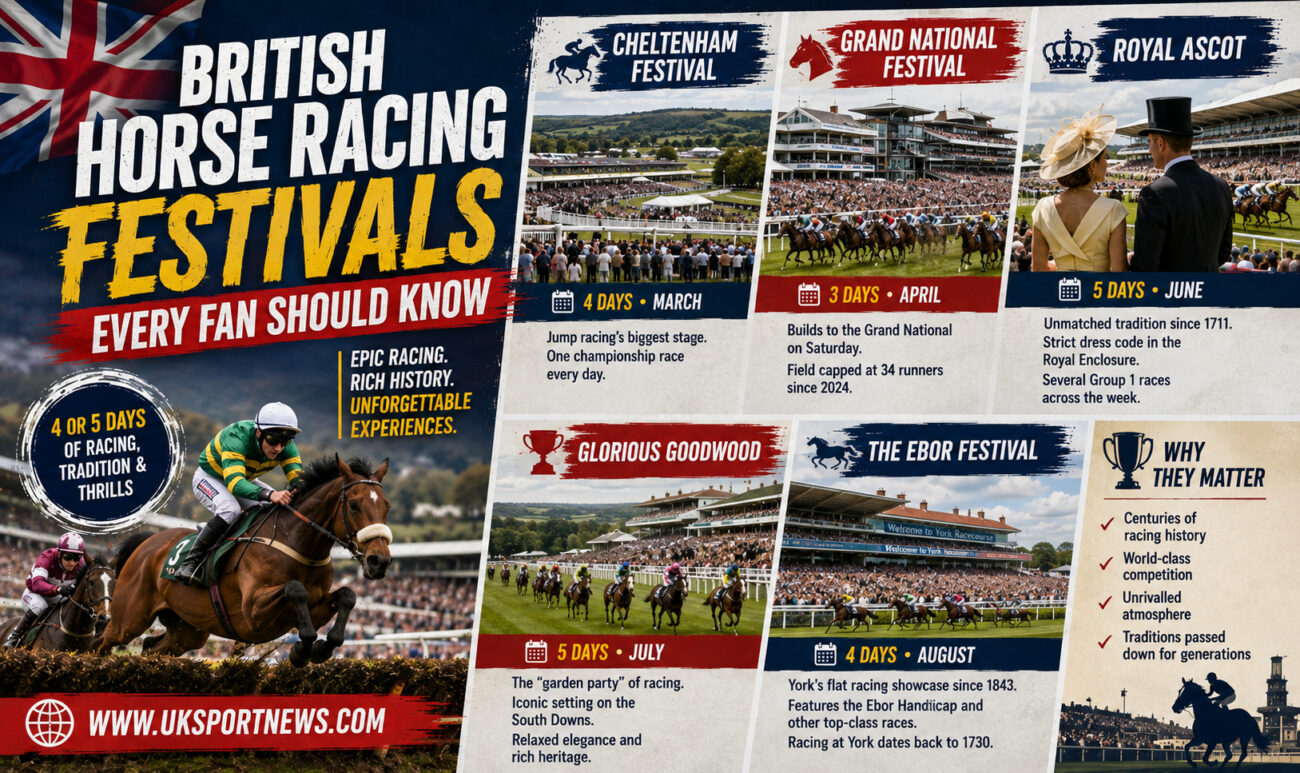
Most major British festivals run for either four or five days.
Cheltenham Festival: Jump Racing’s Biggest Stage
Cheltenham’s roots go back to 1911, when it settled permanently as a National Hunt meeting at Prestbury Park, though racing on the site dates back further still. The Gold Cup arrived in 1924, the Champion Hurdle in 1927, and the Queen Mother Champion Chase in 1959.
Golden Miller remains the benchmark, with five straight Gold Cup wins between 1932 and 1936. The Festival expanded from three days to four in 2005, adding the Ryanair Chase to fill the gap between championship distances.
Each day has its own headline race: the Champion Hurdle on Tuesday, the Queen Mother Champion Chase on Wednesday, the Stayers’ Hurdle on Thursday, and the Gold Cup on Friday.
The Grand National Festival: Three Days at Aintree
Aintree’s big meeting builds toward Saturday’s Grand National, but the two days beforehand carry serious racing of their own, including the Aintree Hurdle and the Bowl Chase. The National itself dates to 1839, the first year the race was officially recorded and won, by a horse called Lottery.
The festival has also become known for its safety reforms. The field size was capped at 34 runners from 2024, down from 40, alongside changes to the start and the fences designed to reduce risk to horses and jockeys.
Friday’s Ladies’ Day and Saturday’s National day are typically the busiest, drawing tens of thousands to Merseyside each spring.
Royal Ascot: Five Days of Tradition
Royal Ascot has run in some form since Queen Anne founded the course in 1711, though the “Royal” character developed later. The Gold Cup, first run in 1807, gave rise to the tradition of Ladies’ Day, and the Royal Procession, a horse-drawn carriage ride down the course, began under King George IV in 1825.
Ascot’s dress code is the strictest of any British horse racing festival. In the Royal Enclosure, men wear morning dress and a top hat, and women wear a hat or fascinator, following conventions that trace back to the dandy Beau Brummell in the early 1800s.
Royal Ascot stages several Group 1 races across its five days, more than any other British meeting in a single week.
Glorious Goodwood: The Garden Party
Goodwood’s founding story starts with the 3rd Duke of Richmond, who held a private race meeting for army officers in 1801 before opening it to the public the following year. The nickname “Glorious Goodwood” stuck during the Victorian era, and King Edward VII’s description of it as “a garden party with racing tacked on” is still quoted today.
Held over five days at the end of July, the meeting features long-standing races like the Sussex Stakes (1841) and the Goodwood Cup (1812), and it’s known for a more relaxed dress code than Ascot despite the equally elegant setting on the South Downs.
The Ebor Festival: York’s Flat Racing Showcase
York’s Ebor Festival dates to 1843, when the Ebor Handicap was first run and named after Eboracum, the Roman name for the city. Racing on the Knavesmire, York’s current course, goes back even further, to 1730.
The four-day meeting each August features the Juddmonte International, the Yorkshire Oaks, the Nunthorpe Stakes, and the Ebor Handicap, now one of Europe’s richest handicap races. It’s widely considered the best flat racing festival outside Royal Ascot.
Racing at York has continued on the Knavesmire for close to 300 years.
Key Takeaways
- Cheltenham Festival: Four days, one championship race per day, established as a permanent meeting in 1911.
- Grand National Festival: Three days at Aintree, capped at 34 runners since 2024.
- Royal Ascot: Five days, running since 1711, with the strictest dress code.
- Glorious Goodwood: Five days on the South Downs, established in 1802.
- Ebor Festival: Four days at York, dating to 1843.
FAQs
How many days does a typical British horse racing festival last?
Most run for either four or five days, with a headline race scheduled for each day of the meeting.
Which festival has the strictest dress code?
Royal Ascot’s Royal Enclosure has the strictest requirements, including morning dress and top hats for men.
Is the Grand National part of a bigger festival?
Yes, the National runs on the Saturday of a three-day Aintree meeting that includes two other days of racing.
What’s the oldest of these festivals?
Royal Ascot has the longest history, with racing at the course dating back to 1711, though its current five-day format developed over time.
Which festival is considered the most relaxed?
Glorious Goodwood and the Ebor Festival are generally seen as more relaxed than Royal Ascot, despite their equally significant racing.
Conclusion
From Cheltenham’s roar in March to York’s Knavesmire in August, British horse racing festivals each bring their own history, their own traditions, and their own reasons to build a trip around them. Whichever one you pick, you’re watching a piece of racing that’s been building its reputation for well over a century.
