British horse racing doesn’t really pause. There’s a meeting somewhere in the country most days of the year. But six events anchor the British horse racing calendar, spaced out from March through August, each one big enough to draw crowds in the tens or hundreds of thousands. Here’s how the year unfolds.
March: The Cheltenham Festival
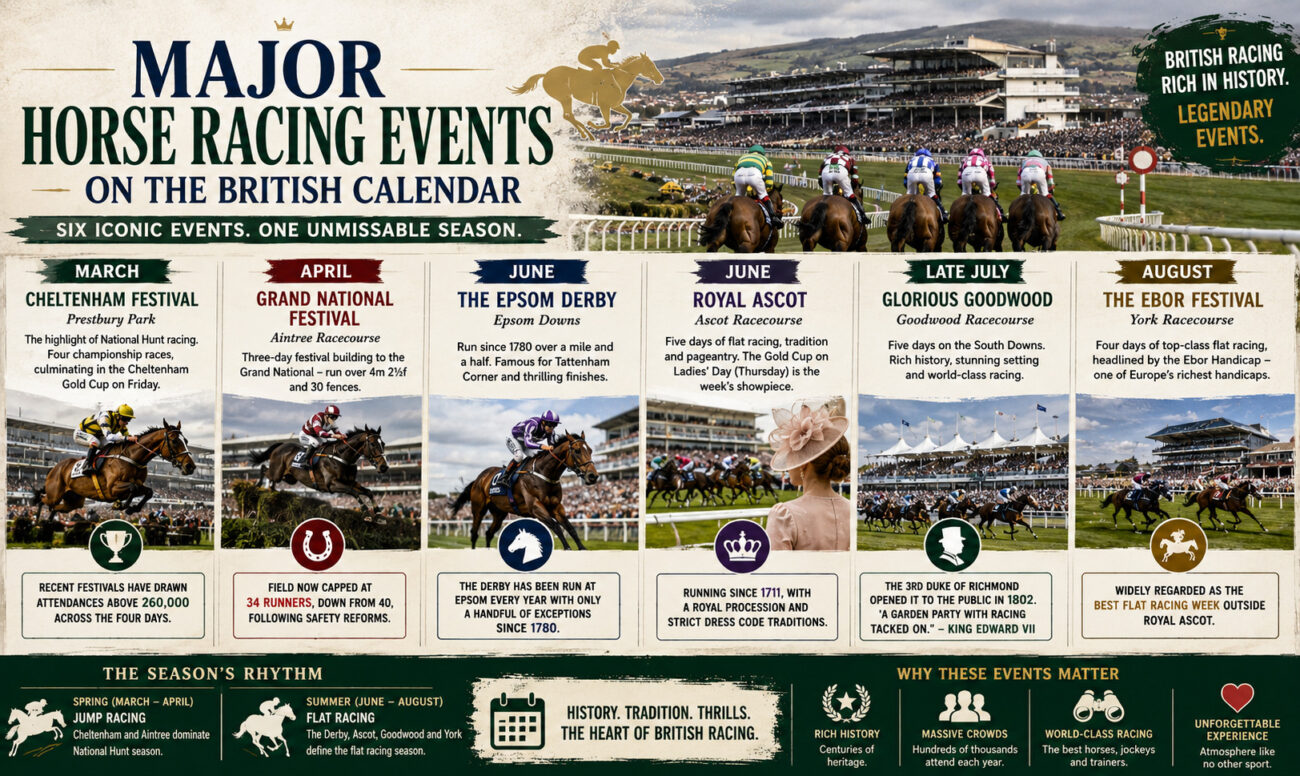
The season’s first major landmark arrives in mid-March, when the Cheltenham Festival takes over Prestbury Park in Gloucestershire for four days. It’s the biggest week in National Hunt racing, and its structure is simple: one championship race headlines each day, the Champion Hurdle on Tuesday, the Queen Mother Champion Chase on Wednesday, the Stayers’ Hurdle on Thursday, and the Cheltenham Gold Cup on Friday.
Recent Festivals have drawn attendances above 260,000 across the four days.
April: The Grand National Festival
Three weeks or so after Cheltenham, attention shifts to Aintree for the Grand National Festival, a three-day meeting that builds toward Saturday’s main event. The National itself is run over four and a quarter miles and 30 fences, and it’s the one race most non-racing fans can name.
Recent safety changes have altered the race noticeably. The field is now capped at 34 runners, down from 40, and the fences and start have both been adjusted to reduce risk. The race still airs to one of the biggest television audiences in British sport each year.
June: The Epsom Derby
Early June belongs to Epsom Downs and the Derby, first run in 1780 and now the template for more than 140 similarly named races around the world. Run over a mile and a half, the race is famous for Tattenham Corner, a sharp downhill bend that can undo even the best-fancied horses before the finish comes into view.
The Derby has been run at Epsom every year with only a handful of exceptions since 1780.
Also in June: Royal Ascot
Royal Ascot follows the Derby by only a couple of weeks, running for five days later in June. The meeting traces back to 1711, when Queen Anne identified a patch of heath near Windsor Castle as ideal for racing, and it’s grown into the most socially significant meeting on the calendar, complete with a strict Royal Enclosure dress code and a daily carriage procession that began under King George IV in 1825.
The Gold Cup, run on the Thursday known as Ladies’ Day, dates to 1807 and remains the week’s most prestigious race.
Late July: Glorious Goodwood
By the end of July, the calendar moves to the South Downs for Glorious Goodwood, a five-day meeting on the Goodwood Estate in West Sussex that the 3rd Duke of Richmond opened to the public in 1802. King Edward VII’s old description of it, “a garden party with racing tacked on,” still captures the mood.
Long-running races like the Sussex Stakes, first run in 1841, and the Goodwood Cup, dating to 1812, headline a week known as much for its setting as its racing.
August: The Ebor Festival
The summer’s flat racing calendar closes with the Ebor Festival at York, a four-day meeting built around the Ebor Handicap, first run in 1843 and named after Eboracum, the Roman name for York. Racing on York’s Knavesmire course goes back further still, to 1730.
The festival features the Juddmonte International, the Yorkshire Oaks, and the Nunthorpe Stakes alongside the Ebor Handicap itself, now among the richest handicap races in Europe. It’s widely regarded as the best flat racing week outside Royal Ascot.
What Ties the Calendar Together
Looking at the year as a whole, there’s a clear rhythm: jump racing dominates the spring, with Cheltenham and Aintree bookending March and April, before flat racing takes over from June onward with the Derby, Royal Ascot, Goodwood, and York.
That split reflects the sport itself. National Hunt racing, over jumps, mostly runs through the autumn and winter and peaks at Cheltenham and Aintree, while flat racing, without obstacles, builds through the summer toward its own showpiece weeks.
Key Takeaways
- March: Cheltenham Festival, four days, headlined by the Gold Cup on Friday.
- April: Grand National Festival at Aintree, now capped at 34 runners.
- June: The Epsom Derby, run since 1780.
- June: Royal Ascot, five days, running since 1711.
- Late July: Glorious Goodwood, five days on the South Downs.
- August: The Ebor Festival at York, dating to 1843.
FAQs
What is the first major event of the British horse racing calendar?
The Cheltenham Festival in mid-March is generally considered the season’s opening landmark event.
How close together are the Derby and Royal Ascot?
They typically run within a couple of weeks of each other, both in June.
Which event closes out the summer flat racing calendar?
The Ebor Festival at York in August is generally seen as the last major meeting of the flat season’s peak period.
Is the Grand National always run in April?
Yes, the Grand National Festival is traditionally held in early April each year.
Why does jump racing dominate the spring calendar?
National Hunt racing runs mainly through autumn and winter, building to its two biggest events, Cheltenham and Aintree, before flat racing takes over for the summer.
Conclusion
From Cheltenham’s roar in March to York’s Knavesmire in August, the British horse racing calendar builds steadily through the year, jump racing first, then flat racing through the summer. Each event carries its own history, and together they make up one of the most consistent sporting calendars anywhere in the world.
