Few things in sport carry the weight of a proper derby day. When two clubs share a city, a border, or decades of bad blood, the football on show becomes secondary to the history behind it. These are the UK football rivalries that still stop entire towns on a Saturday afternoon, and understanding them tells you almost everything about why English and Scottish football means so much to the people who live it.
What makes UK football rivalries so intense
Most football rivalries are built on proximity, but the best ones run deeper than a shared postcode. Religion, class, industry, and civic pride have all shaped the fiercest football derbies in Britain.
A rivalry only earns “iconic” status when it survives relegation, financial collapse, and changes in ownership. That’s the filter used here. Every club on this list has been through a rough patch, sometimes more than one, and the rivalry outlasted it every time.
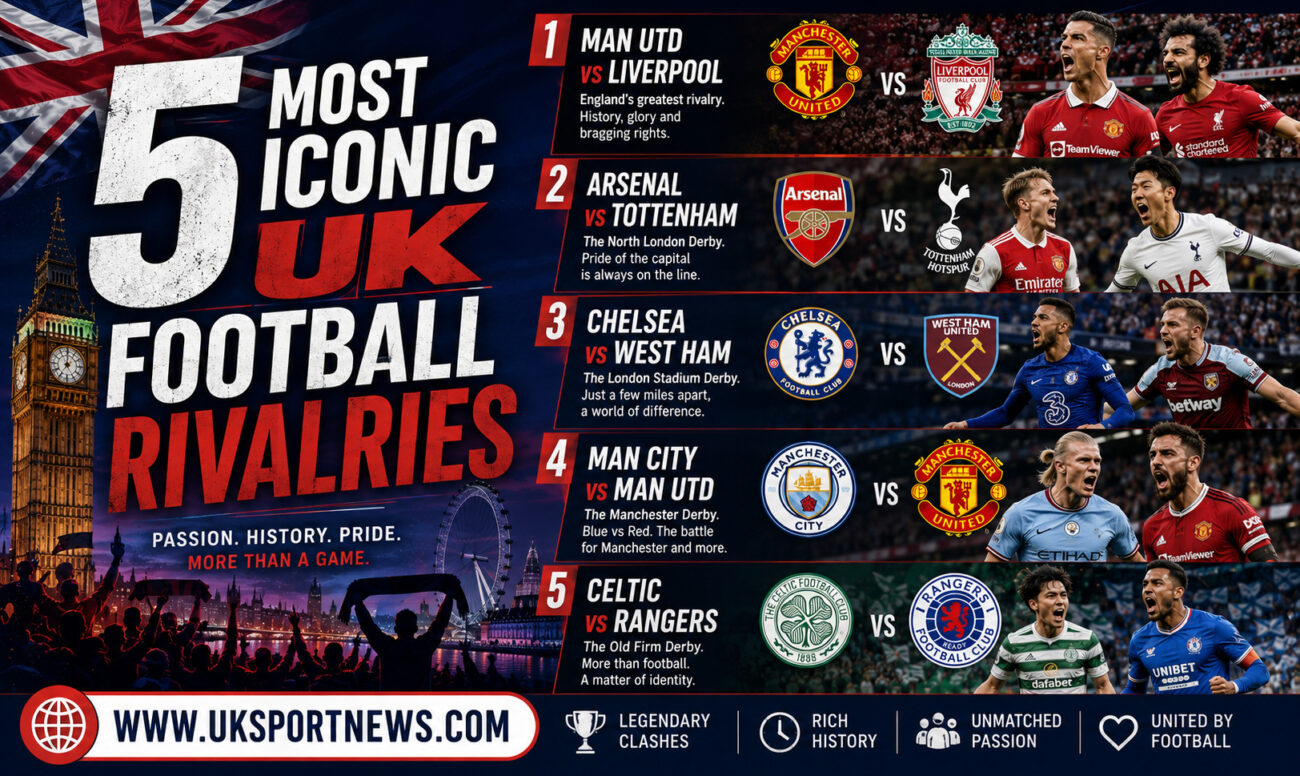
Manchester United vs Manchester City
From noisy neighbours to genuine title race
For most of the twentieth century, this was a one-sided affair. United had the trophies, the European nights, and the global brand under Sir Alex Ferguson. City were the club everyone in Manchester quietly felt sorry for, stuck in United’s shadow even during their own good spells.
That changed in 2008, when City were bought by Abu Dhabi United Group. The spending that followed turned City into genuine title contenders, and Ferguson himself coined the phrase “noisy neighbours” to describe them, a line that’s followed the rivalry ever since.
The turning point most fans point to is City winning the title at Etihad Stadium in May 2012 with two stoppage-time goals against QPR, snatching the championship from United on goal difference. Since then City have won multiple Premier League titles, including a domestic and European treble in the 2022-23 season, flipping the local hierarchy on its head.
United still hold the higher overall head-to-head record across the full history of the fixture. But City’s rise has made this one of the most financially significant Premier League rivalries in the world, and both clubs have met each other in cup finals too, adding extra edge beyond league fixtures.
Liverpool vs Everton
The Merseyside derby and its complicated “friendly” reputation
Liverpool and Everton share a boundary, a park, and in some cases a family tree. It’s common to find households on Merseyside split between red and blue, which is part of why this fixture was nicknamed the “friendly derby” for decades.
That label has worn thin in recent years. The 2023 meeting at Anfield saw Everton’s Anthony Gordon controversially avoid a red card for a challenge on Liverpool’s Andy Robertson, and tempers on the pitch have generally run hotter since Everton’s relegation battles began piling up. The football itself has stayed fierce even as Everton’s on-field fortunes dipped, with the club fighting off relegation in consecutive seasons before their move away from Goodison Park.
What keeps this rivalry alive isn’t silverware, since Liverpool have dominated that department for years. It’s identity. Everton fans see themselves as the original Merseyside club, older than Liverpool FC itself, and that sense of being the underdog with the longer history fuels every derby regardless of league position.
Celtic vs Rangers: The Old Firm
Scotland’s rivalry built on more than football
No conversation about UK football rivalries is complete without the Old Firm. Celtic and Rangers are two Glasgow clubs whose rivalry has historically carried religious and political weight, tied to Catholic and Protestant communities respectively, alongside broader Irish and British identity questions.
The football side has been just as dramatic. Rangers went into liquidation in 2012 and were effectively relaunched, dropping down to Scotland’s fourth tier and working their way back up over several seasons. That period without a top-flight Old Firm fixture only made the eventual return of the derby feel bigger.
Celtic have enjoyed long stretches of domestic dominance, including a run of consecutive league titles through much of the 2010s and into the 2020s, though Rangers have interrupted that streak at points, most notably breaking a nine-year title drought during the 2020-21 season, played largely behind closed doors due to COVID restrictions.
A few things separate this fixture from everything else on the list. Ibrox and Celtic Park regularly produce some of the loudest atmospheres anywhere in British football. The clubs can meet four times or more in a single season across league and cup competitions. And the rivalry carries genuine social and historical weight beyond sport, which is unusual even among fierce derbies.
Arsenal vs Tottenham Hotspur
The North London derby
Arsenal and Tottenham sit roughly four miles apart, and the rivalry between them is as much about bragging rights across the city as it is about the league table. Arsenal’s move from Highbury to the Emirates Stadium did nothing to cool things down; if anything it gave both fanbases a fresh stadium to argue about.
Arsenal’s Invincibles season in 2003-04, when the club went the entire league campaign unbeaten, remains a sore point for Spurs supporters to this day. Tottenham have had their own high points, including reaching the 2019 Champions League final under Mauricio Pochettino, a run that briefly shifted bragging rights their way even without silverware to show for it.
Harry Kane’s rise through Tottenham’s academy and eventual departure to Bayern Munich in 2023 added a strange subplot, since Arsenal fans had long enjoyed reminding Spurs supporters that their record goalscorer had never lifted a major trophy at the club. That dynamic shows how personal this rivalry gets. It’s rarely just about the two clubs; it’s about individual players and moments that get replayed in pub arguments for years.
Newcastle United vs Sunderland
The Tyne-Wear derby’s north-east identity
Away from London, Manchester, and Glasgow, the Tyne-Wear derby between Newcastle and Sunderland represents something different: pure regional pride with limited crossover between fanbases, unlike the family-split nature of the Merseyside derby.
For a stretch of the 2010s, this fixture nearly disappeared from the calendar after Sunderland suffered back-to-back relegations, dropping as far as League One. Newcastle’s own struggles under previous ownership, followed by the 2021 Saudi-backed takeover that transformed the club’s finances and ambitions, changed the balance of power again, with Newcastle returning to European football and Sunderland working their way back toward the Premier League.
What makes this one worth including alongside the bigger city rivalries is the raw intensity of the crowd. St James’ Park and the Stadium of Light both produce atmospheres that outsiders often rank above fixtures with far bigger reputations, and local pride here has never depended on which division either club happens to be playing in.
How these rivalries compare today
Ranking rivalries is subjective, but a few patterns stand out across all five. Manchester United vs Manchester City is shaped heavily by ownership and spending power. Celtic vs Rangers and Newcastle vs Sunderland run on regional or cultural pride more than recent form. Liverpool vs Everton is unusual because loyalty doesn’t always follow geography in a straight line. And Arsenal vs Tottenham thrives on moments and individual players as much as trophies.
None of these rivalries need a title race to matter. A mid-table Sunday afternoon fixture between these clubs still carries weight that a Tuesday night Champions League group game between two unfamiliar sides never will.
FAQ: UK football rivalries
Which is the oldest football rivalry in the UK?
The Merseyside derby between Liverpool and Everton is widely considered one of the oldest continuous top-flight rivalries in English football, with Everton’s roots at Anfield predating Liverpool FC’s own formation there.
Is the Old Firm the most intense rivalry in British football?
Many fans and pundits rank Celtic vs Rangers as the most intense UK football rivalry because of its historical, religious, and political dimensions, which go beyond what most club rivalries carry.
Why is the Manchester derby considered a newer rivalry?
Manchester City only became a consistent title threat after their 2008 takeover, so while the fixture is old, the modern intensity and stakes largely date back to the last fifteen years or so.
Do these rivalries affect transfer decisions?
Yes. Players have historically avoided moving directly between fierce rivals, though it does happen occasionally. When it does, as with a handful of transfers between Liverpool and Everton over the decades, it tends to generate significant backlash from supporters.
