
In May 2023, Luton Town completed a nine-year climb from the depths of the fifth tier to the Premier League by defeating Coventry City on penalties. That single, dramatic journey illustrates why the English football league system stands apart in the global sporting landscape. No other structure offers such ruthless jeopardy or such open-ended hope for local communities.
The core of the system
The English football league system operates as a massive, interconnected ladder. This football pyramid connects the immense wealth of the Premier League all the way down to amateur weekend pub teams playing on muddy municipal pitches.
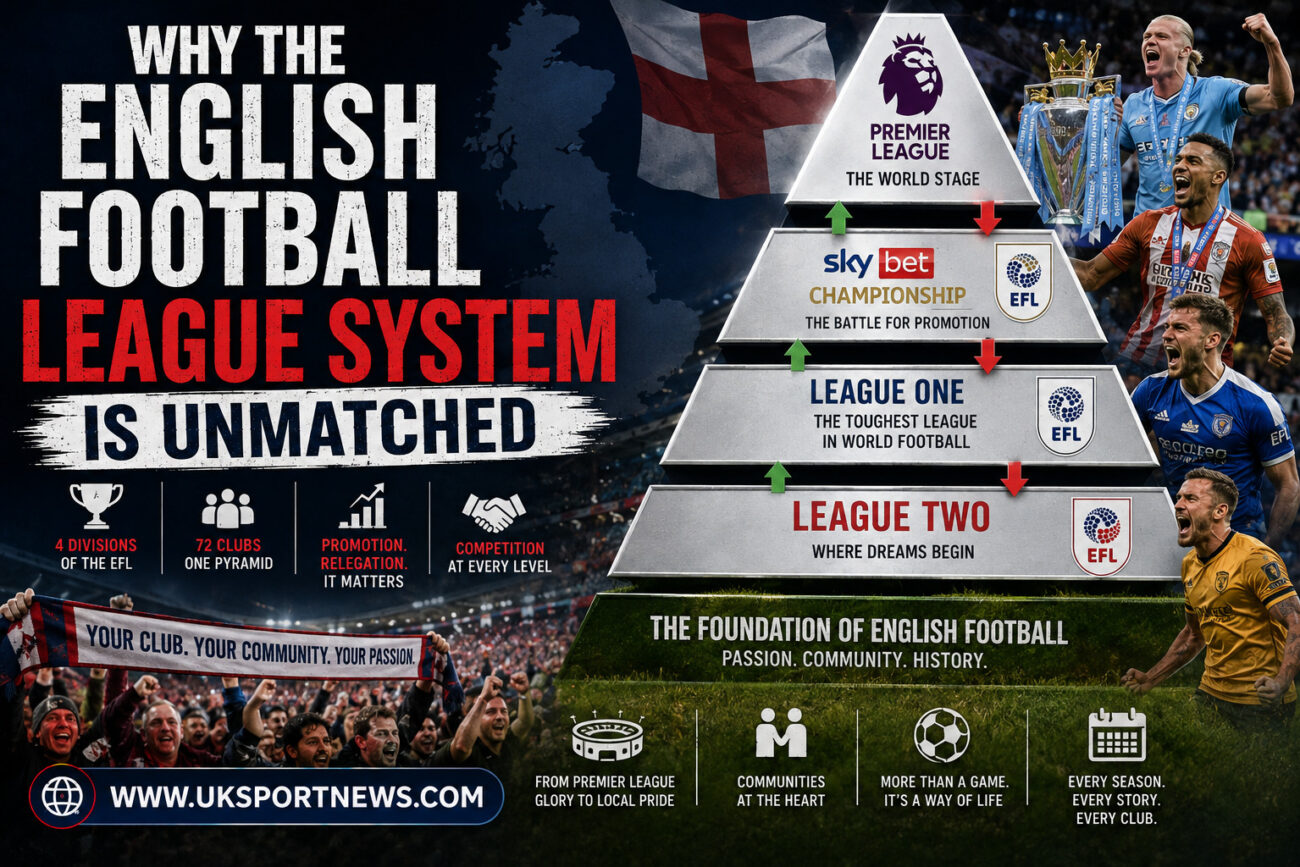
There are at least eleven officially recognized levels within the men’s and women’s divisions. The top four tiers make up the fully professional ranks; below that, the structure expands outward into regional divisions. At the very top sits the Premier League, featuring twenty of the richest clubs in the world. Just below it is the EFL Championship, followed by EFL League One and EFL League Two. Every division is linked by the promise of upward mobility, meaning a team can theoretically start at the absolute bottom and win their way to a European championship.
How promotion and relegation fuel the passion
American sports often rely on closed franchise models where losing has no permanent consequence. The English system rejects that safety net entirely. Promotion and relegation dictate that success on the pitch is rewarded with upward mobility, while persistent failure is punished with a drop to a lower, less lucrative division.
When a club falls out of the top flight, the financial and emotional impact is significant. Fans don’t just watch their team lose a few matches over a weekend; they watch their entire community lose global status and broadcasting revenue. That threat forces owners to invest in their playing squads, and it’s part of why late-season matches between struggling teams become so compelling: a relegation dogfight in May is often just as gripping as a title race at the top of the table.
The magic of non-league football
You can’t fully grasp the sport without visiting a match in the lower divisions. Non-league football, the clubs operating at step five and below, is where million-dollar contracts are replaced by part-time wages and pure passion.
At these lower levels, fans stand just yards from the pitch. You’ll regularly see supporters chatting with the goalkeeper during a lull in play or volunteering to paint the stadium bleachers over the summer. Clubs at this level also serve as community hubs: they host charity events, run youth academies, and provide a sense of identity for small towns that might otherwise be forgotten. Their survival relies entirely on the dedication of local volunteers.
Financial stakes and attendance figures
One of the more surprising things for foreign fans is the sheer number of people attending lower division matches. English second-tier clubs regularly draw larger crowds than top-tier teams in other major European nations, a depth of support that’s hard to find anywhere else.
During recent seasons, Championship clubs like Coventry City and Derby County regularly recorded average attendances near 30,000 fans. Even down in the third tier, stadiums frequently host over 15,000 supporters every weekend. Those numbers reflect deeply rooted local loyalty rather than fair-weather fandom: fans support their local town rather than picking a winning team on television, ticket prices in the lower levels are often more accessible for working-class families priced out of elite stadiums, and the constant threat of promotion and relegation means almost every match holds real meaning for the club.
Luton Town as the ultimate example
If you want a real-world example of how the system changes clubs’ fortunes, look at Luton Town. In 2014, they were playing non-league football in the Conference Premier. Less than a decade later, they were hosting Manchester City and Arsenal at Kenilworth Road.
They earned consecutive promotions from League Two and League One in 2018 and 2019, and by 2023 they’d navigated the Championship playoffs to reach the top flight. It’s the kind of climb that’s hard to imagine happening in most other sporting structures.
The system works a bit like a massive game of corporate snakes and ladders. One bad financial decision can send a wealthy owner plummeting down the board, while a smart, locally run club with a clear vision can climb to the very top.
Comparing the pyramid to closed leagues
Proposals for closed competitions have consistently failed to win over true football supporters. The English system thrives precisely because nobody is ever entirely safe. When elite clubs tried to break away into a closed league a few years ago, fans protested in the streets because the proposal threatened the integrity of the whole pyramid.
Without the risk of relegation, late-season matches between struggling teams become meaningless exhibitions; the promotion and relegation system ensures every point matters, whether a team is fighting for a championship or battling to survive in League Two. The end-of-season playoffs are the sharpest example of this, with teams battling in high-stakes knockout matches for the final promotion spot, producing moments of drama that closed franchise systems simply don’t generate.
Frequently asked questions
What exactly is the English football league system?
The English football league system is a hierarchical framework of interconnected leagues for men and women. It allows clubs to move up and down based on their total points tally at the end of each season.
How many tiers exist in the football pyramid?
There are 11 officially recognized levels in the primary structure. However, regional feeder leagues push the actual number much deeper into the grassroots level, connecting thousands of local amateur clubs.
Do teams from non-league football ever reach the top?
Yes, they absolutely do. Luton Town is the most famous modern example. They successfully climbed from the fifth tier all the way to the Premier League in just nine remarkable years.
How does promotion and relegation actually work?
At the end of a season, the teams with the lowest points in a division are sent down to the tier below. The teams with the highest points in that lower division are promoted to take their place, ensuring constant turnover and competitive balance.
