
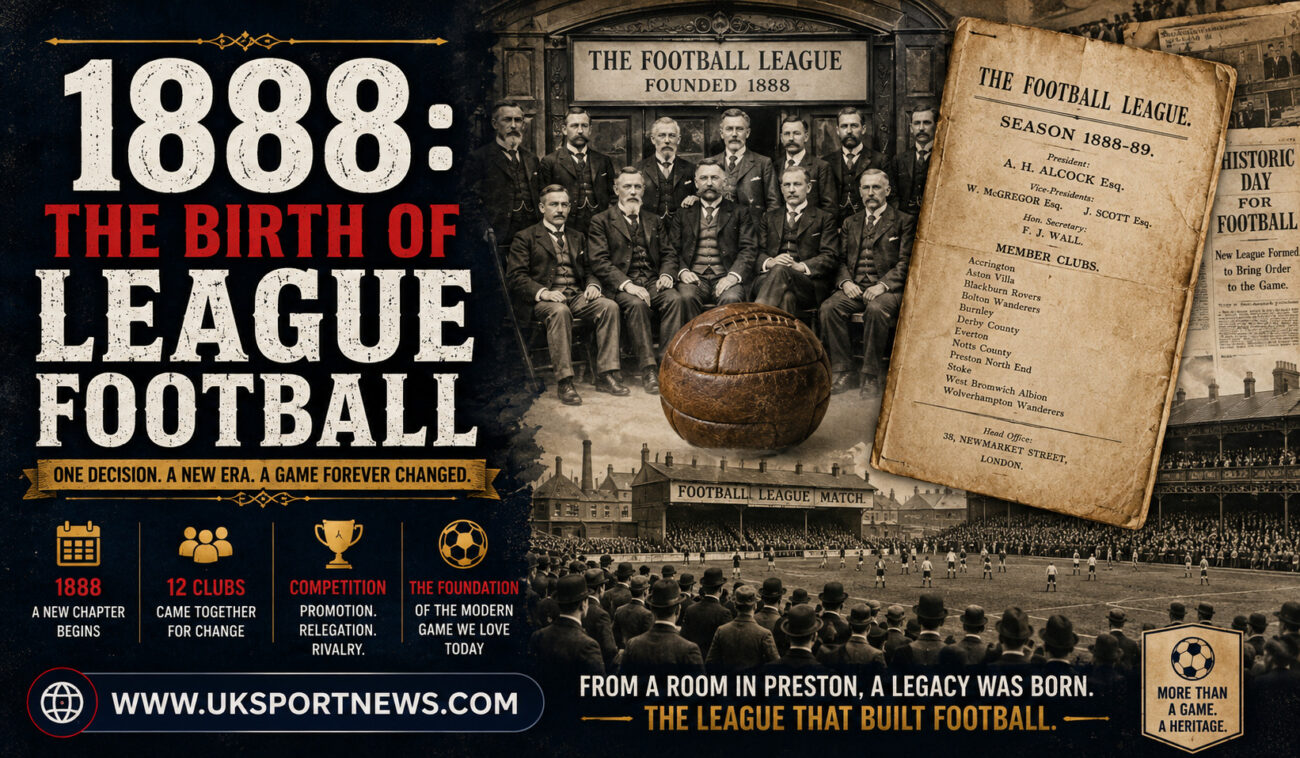
Before 1888, English football was a patchwork of one-off cup ties and friendlies. There was no proper table, no fixed schedule, and no real way to crown a champion. The 1888 Football League changed that in a single season, and it did so with a team from Preston that went the whole campaign without losing a match.
Why English football needed a league in 1888
By the mid-1880s, football in England had a problem. The FA Cup was well established, but clubs outside the cup rounds were often left playing meaningless friendlies for weeks at a time. There was no structure guaranteeing regular, competitive fixtures, and for the growing number of professional clubs in the North and Midlands, that was a real financial issue.
Professionalism had only been legalised by the Football Association in 1885, and clubs paying wages needed reliable gate receipts to survive. A friendly against a weak local side did not pull in the same crowd as a fixture that actually meant something. Something had to give, and the man who pushed hardest for a solution was a Scottish-born draper running a football club in Birmingham.
William McGregor and the founding of the Football League
William McGregor, a director at Aston Villa, is generally credited as the driving force behind the league system. In March 1888, he wrote to several club representatives proposing a fixed schedule of home and away matches between a set group of clubs. He argued that regular, competitive football was the only way to keep crowds and revenue steady through the season.
The idea wasn’t universally popular at first. Some clubs worried about losing control over their own fixture lists, and there was real debate over which clubs deserved a place in the new competition. Even so, the proposal moved quickly, and by April 1888 the Football League was formally created.
The twelve founding clubs
The inaugural Football League season kicked off with twelve clubs, all from the North and Midlands of England, since southern clubs at the time were still largely committed to amateur status. The founding members were Preston North End, Aston Villa, Wolverhampton Wanderers, Blackburn Rovers, Bolton Wanderers, Burnley, Derby County, Everton, Accrington, Notts County, Stoke, and West Bromwich Albion.
Several of those names still populate English football today. A handful, Accrington most notably, disappeared from the top flight entirely and the original club folded decades later.
Preston North End’s Invincible season
If one story defines that first season, it belongs to Preston North End. Nicknamed the Invincibles, Preston went through the entire 22-match league campaign without losing a single game, finishing with 18 wins and 4 draws.
That record gave them 40 points under the two-points-for-a-win system used at the time, well clear of Aston Villa in second place. Preston’s squad, built around players like Fred Dewhurst and captain Bob Holmes, played a passing style considered advanced for the era, when many rival sides still leaned on individual dribbling and long punts forward.
The double that defined a season
Preston didn’t stop at the league title. That same season they also won the FA Cup, beating Wolverhampton Wanderers 3-0 in the final without conceding a single goal across the entire cup run. That made them the first club in English football to win the league and cup double in the same season, a feat that wasn’t repeated for decades.
Winning any domestic double is rare enough today, with squads rotated across multiple competitions. Doing it in the very first season a proper league existed, with essentially no blueprint to follow, says a lot about how far ahead of most of their rivals Preston were at the time.
How the first season was structured
The format of the 1888-89 season looks almost quaint by modern standards, but it set the template English football still uses in some form today. Twelve clubs played each other home and away, a fixed structure that guaranteed every club 22 matches. Wins were worth two points and draws one, the system that stayed in place in English football until three points for a win arrived in 1981. There was no relegation or promotion in that first year; the league only began linking with the Football Alliance for promotion and relegation a few seasons later. There wasn’t even an official trophy at first, the championship was recognised through the table itself rather than a physical prize.
Compared to a modern first season, this was bare bones. There was no televised coverage, no squad numbers, and travel between fixtures relied entirely on rail links, which is part of why the founding clubs were clustered in the North and Midlands rather than spread across the whole country.
The legacy of 1888
A lot of today’s football structure traces back to that 1888 season: a regular table, weekly fixtures against a fixed set of opponents, and a champion decided over a full campaign rather than a single knockout tie. That model became the standard not just in England but eventually across most of world football.
McGregor’s financial logic, that regular competitive fixtures protect a club’s income, still explains why leagues around the world are built the way they are. It’s a bit like a shop moving from relying on passing customers to signing up regulars with a loyalty scheme: predictability, not just quality, is what keeps the business alive.
Preston’s achievement also set a standard that has rarely been matched. It took over a century before another English top-flight side, Arsenal in the 2003-04 season under Arsene Wenger, went a full league campaign unbeaten. Even that Arsenal side, playing a longer 38-game season, didn’t match Preston’s combination of an unbeaten league campaign and a clean-sheet cup run in the same year.
Comparing 1888 to today’s Premier League
Set the original 1888 Football League side by side with the modern Premier League and the differences, and a few constants, become clear. Twelve clubs in 1888 compares to twenty in today’s Premier League, with a much larger pyramid of divisions beneath it now. The two-points-for-a-win rule lasted almost a century before England switched to three points in 1981, a change meant to reward attacking football over cautious draws. The founding clubs were entirely northern and Midlands based, while the modern top flight is spread nationwide. And Victorian gate receipts covering modest professional wages bear almost no resemblance to the broadcasting deals and global sponsorships funding Premier League and Football League clubs today.
What hasn’t changed is the basic appeal: a club chasing an unbeaten record, a title race decided on the final weekend, a cup upset nobody saw coming. All of it traces back to a format invented to solve a fairly boring administrative problem in 1888.
FAQ: The 1888 Football League
Who founded the Football League in 1888? William McGregor, a director at Aston Villa, proposed a fixed league schedule in March 1888, and the Football League was formally established the following month with twelve founding clubs.
Which club won the first Football League title? Preston North End won the inaugural 1888-89 season unbeaten, finishing with 18 wins and 4 draws from 22 matches, and won the FA Cup that same season to complete English football’s first domestic double.
How many clubs were in the first football league season? The original Football League had twelve clubs, all based in the North and Midlands of England, since football hadn’t yet developed the same professional presence in the south.
Did the 1888 Football League always use three points for a win? No. The league used two points for a win and one for a draw from its founding in 1888 until England adopted three points for a win in 1981, a change made to encourage more attacking football.
