
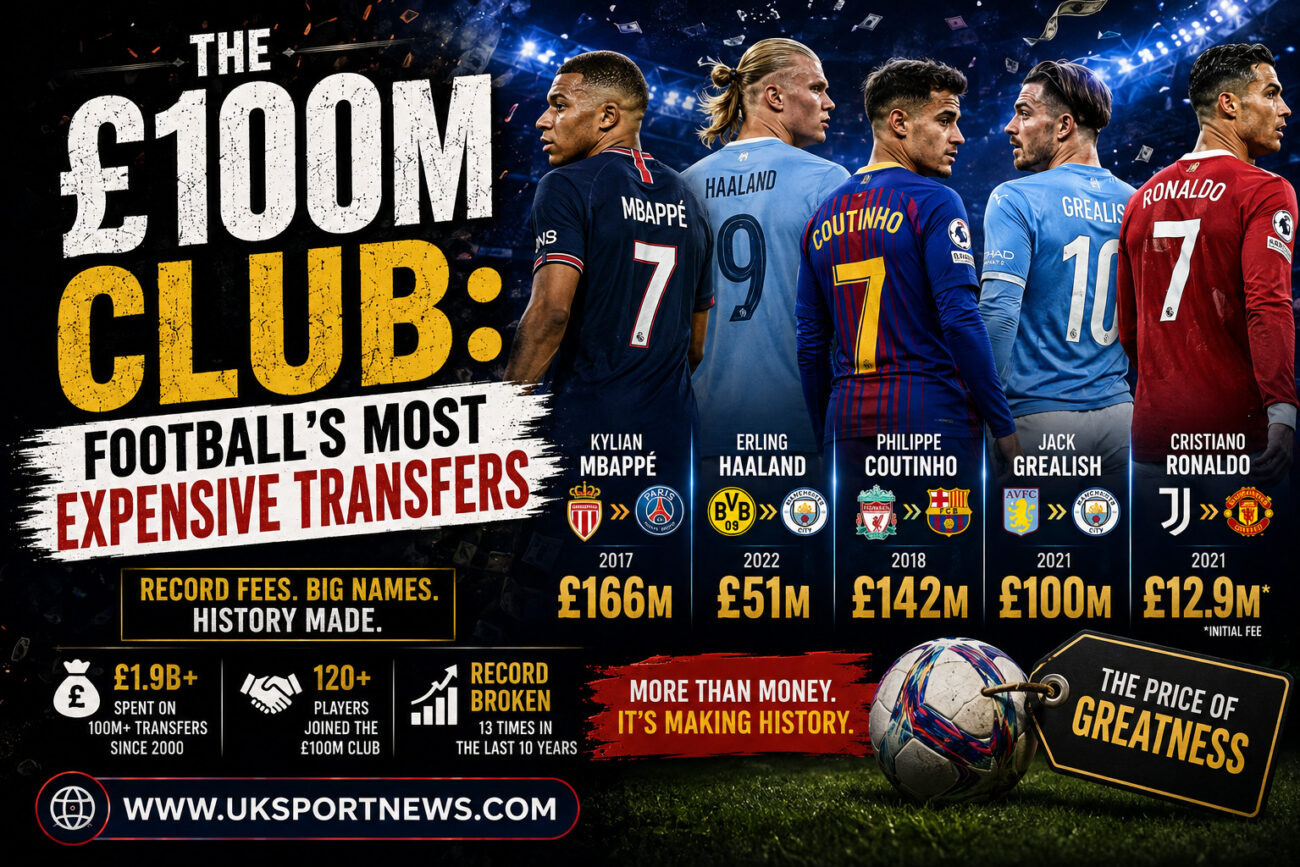
Ten years ago, a £100m transfer fee sounded like a typo. Today it barely cracks the top twenty. The most expensive football transfers of all time now read like a list of national GDPs, and new names keep joining the £100m club faster than the last one had time to settle in. Here’s how the list actually stacks up, and what it says about where the game is heading.
Why Transfer Fees Exploded The Way They Did
Football didn’t just wake up one day with more money lying around. Broadcast deals grew fast across the Premier League, La Liga, and beyond, and that cash had to go somewhere. Add state-backed ownership at clubs like PSG and Manchester City, plus Saudi clubs entering the market with real spending power, and you get a transfer economy that barely resembles what it looked like fifteen years ago.
There’s a psychological piece to this too. Once one club pays £150m for a player, the next £120m deal suddenly looks almost reasonable by comparison. Fees don’t just reflect a player’s ability anymore, they reflect what a buying club can afford and what a selling club knows it can extract.
The Most Expensive Football Transfers Of All Time, Ranked
A quick note before the list: reported figures often vary between sources depending on whether add-ons and bonuses are counted, so these are the commonly cited guaranteed fees rather than exact final totals.
- Neymar (Barcelona to Paris Saint-Germain, 2017): around £200m
- Kylian Mbappé (AS Monaco to Paris Saint-Germain, 2018): around £162m
- Ousmane Dembélé (Borussia Dortmund to Barcelona, 2017): reported around €148m, roughly £130m at the time
- Alexander Isak (Newcastle United to Liverpool, 2025): around £125m
- Morgan Rogers (Aston Villa to Chelsea, 2026): around £117m
- Elliot Anderson (Nottingham Forest to Manchester City, 2026): around £116m
- Moises Caicedo (Brighton to Chelsea, 2023): around £115m
- Enzo Fernández (Benfica to Chelsea, 2023): around £107m
- Declan Rice (West Ham to Arsenal, 2023): around £105m
- Jack Grealish (Aston Villa to Manchester City, 2021): £100m
Neymar’s move has now stood at the top for close to a decade, which is remarkable given how much the market has shifted underneath it. Every deal since has chased that number without quite reaching it.
The Premier League’s Growing Grip On The List
What jumps out fastest here is how many of these deals now run through England. Chelsea alone has three entries in the top ten from a single summer in 2023, when the club spent hundreds of millions rebuilding its squad almost from scratch under new ownership. Add Manchester City, Arsenal, and Liverpool, and the Premier League isn’t just competing at the top of this list, it’s dominating the middle and lower sections too.
Domestic and international broadcast revenue for the Premier League now dwarfs every other league in world football, and that gap shows up directly in transfer spending.
Chelsea’s 2023 Spending Spree: A Case Study
Chelsea’s approach in 2023 is worth a closer look, because it changed how people talk about squad building. Signing Caicedo, Enzo Fernández, and several other high-fee players in a single window wasn’t normal recruitment, it was closer to a hostile takeover of the transfer market.
The results on the pitch were mixed at first, which sparked plenty of debate about whether raw spending power actually translates into results. Building a competitive squad takes more than outspending everyone else. Chemistry, tactical fit, and squad balance still matter, and Chelsea’s early struggles after that spree proved it. Over time the club settled into a more coherent identity under its rebuilt structure, but the early lesson stuck: money buys players, it doesn’t automatically buy a functioning team.
Do These Fees Actually Deliver Value?
A big transfer fee is not a guarantee of anything. Some deals on this list have paid off spectacularly. Others have become cautionary tales that get brought up every time a new mega deal is announced.
A £100m transfer fee is a bit like a mortgage on a house you’ve never actually lived in. You’re betting on future performance based on past form, age, potential, and a highlight reel, but nobody truly knows how a player will handle the pressure, the league, or the dressing room until they’re already there.
- Some record fees, like Mbappé’s, have aged extremely well given his consistent output at the top level.
- Others have struggled with injuries or adaptation issues that no amount of scouting could have fully predicted.
- Fee size and squad impact don’t always move together, since a £100m signing can still get outplayed by an academy graduate on a bad day.
What The £100m Club Means For The Future Of Football
How high can these numbers actually go? Neymar’s fee has survived nearly ten years at the top, but the gap between it and the current chasing pack keeps shrinking. Isak, Rogers, and Anderson all arrived within the last two years alone, and each one pushed the average fee for a top-tier transfer a little higher than it was the summer before.
If Premier League broadcast money keeps growing and state-backed clubs keep competing for the same handful of elite players, a new world record transfer fee looks less like a possibility and more like a matter of scheduling. The only real question is which club blinks first, and which player becomes the next name at the top of this list.
Frequently Asked Questions
What is the most expensive football transfer of all time?
Neymar’s 2017 move from Barcelona to Paris Saint-Germain, at a reported fee of around £200m.
Why have transfer fees increased so much in recent years?
Growing broadcast revenue, especially in the Premier League, combined with state-backed ownership at several major clubs.
Has anyone broken Neymar’s record?
Not yet. Mbappé’s move to PSG came closest, but Neymar’s fee still tops the list.
Do expensive transfers always pay off?
No. Some deliver strong returns; others struggle with injuries, poor fit, or adaptation issues, which shows fee size alone doesn’t guarantee success.
