
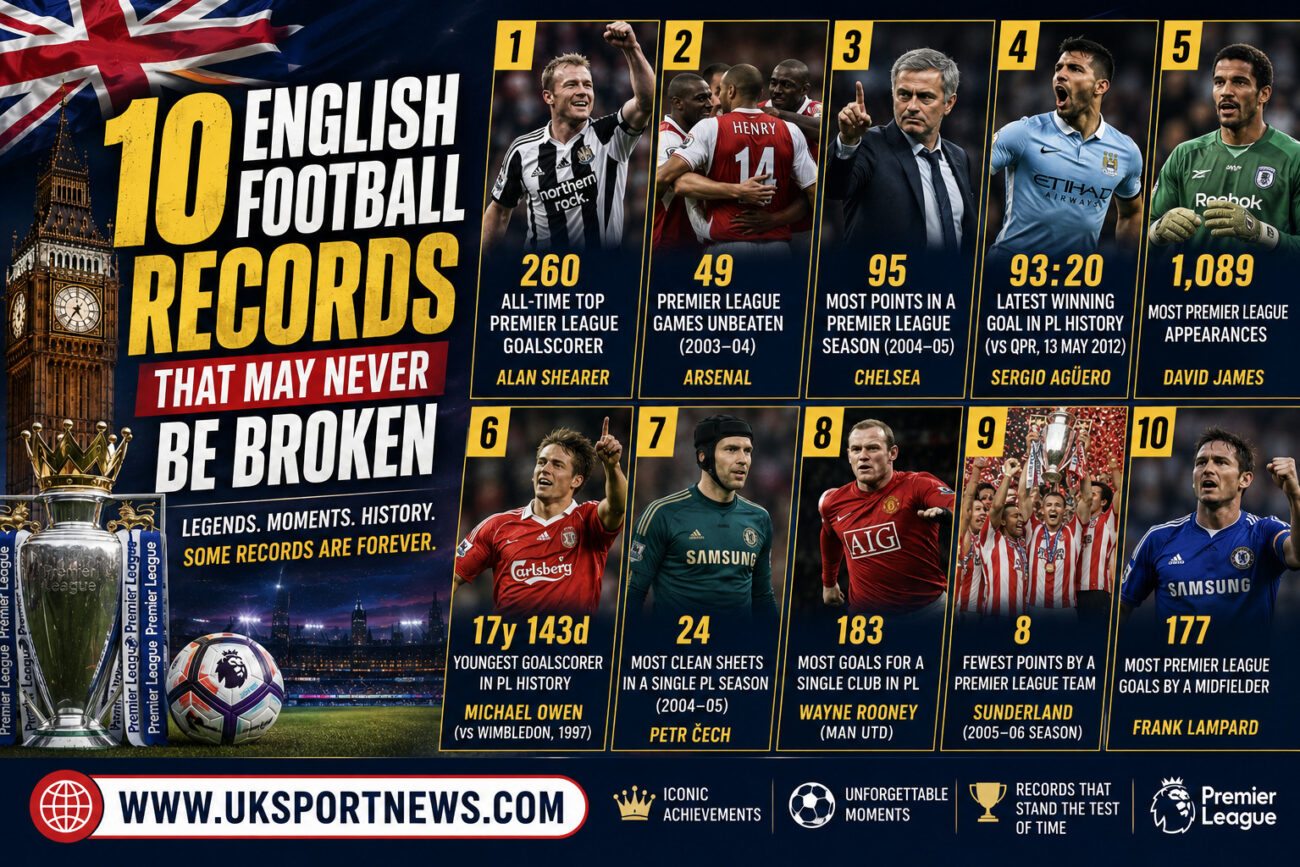
Alan Shearer scored 260 Premier League goals and retired in 2006. Nobody has come within touching distance of it since. That single stat says a lot about why certain records in English football stop feeling like targets and start feeling permanent.
Why some records just don’t move
Football is supposed to make old records easier to beat, not harder. Squads rotate, sports science keeps players fit for longer, tactics change almost every season. And yet a handful of achievements have sat untouched for decades.
Some of these records were built on conditions that don’t exist anymore — a 42-team fixture list, a striker playing every minute of every match. Others came from one unrepeatable stretch of form lining up at exactly the right moment. Either way, they say something about how the game actually works now.
Goal-scoring
Dixie Dean, 60 goals in a season (1927-28). Long before the Premier League existed, Everton’s Dean scored 60 league goals in a single campaign — still the record for a single English top-flight season, nearly a century later. Modern strikers don’t get the chance to attempt this. Between rotation, rest periods, and a shorter season than the old First Division ran, even the most clinical forwards are happy to hit 30. Dean’s number is double that.
Alan Shearer, 260 Premier League goals. Scored across Blackburn and Newcastle, standing since 2006. Plenty of prolific strikers have come and gone since without threatening it. The difference is mostly longevity — Shearer stayed fit and productive for a long time, at a stretch when injuries derailed far fewer top strikers than they do now.
Team dominance
Arsenal’s 49-game unbeaten run. The Invincibles went through all of 2003-04 without losing, then kept going until Manchester United finally beat them in October 2004. Nobody’s come close since, not even City under Guardiola. A run that long needs a team to avoid injuries, avoid complacency, and avoid one bad afternoon for well over a year straight — a lot has to go right for a very long time.
Manchester City’s 100-point season (2017-18). Nobody had reached 100 points before, and nobody’s matched it since — including City’s own later title-winning sides. That says something about how many things had to break their way at once: one injury crisis or one bad month and the total drops fast.
Defense
Chelsea, 15 goals conceded (2004-05). Mourinho’s first Chelsea team let in just 15 goals all season — Cech in goal, Terry, Carvalho, Ferreira and Gallas in front of him, Makelele shielding the back four. Nobody’s touched it since; the closest anyone’s managed is around 22, which sounds close but is a real gap over 38 games. That kind of defense needs continuity in personnel and system that clubs rarely hold onto for a full season now.
Derby County, 11 points (2007-08). The worst Premier League season on record — one win from 38 games. Sunderland’s 15 points in 2005-06 is the next-worst total, which tells you how far below everyone else Derby actually fell. Repeating it would take a near-impossible combination of bad squad, bad injuries, and bad management all at once.
Individual records
Sadio Mané’s fastest hat-trick. Three goals in two minutes and 56 seconds, for Southampton against Aston Villa on 16 May 2015, beating Robbie Fowler’s mark from 1994. This one depends on everything lining up inside a single match rather than across a season — three clear chances, three clean finishes, under three minutes. That randomness is exactly why nobody’s matched it.
Ryan Giggs, 162 Premier League assists. All of it built at one club, across more than two decades at Manchester United. Players move far more often now, and careers rarely stretch that long at the top level anymore — loyalty plus longevity together is a rare combination.
Gareth Barry, most Premier League appearances. Spread across Aston Villa, Manchester City and Everton — staying fit, staying relevant, staying picked for the better part of twenty years. It’s the football equivalent of a marathon runner who never has to stop, for injury, form, or a manager who fancies someone else instead.
The manager
Sir Alex Ferguson spent 26 years in charge at Manchester United and won 13 Premier League titles in that time. In an era where managers get sacked after one bad season, a tenure that long is hard to picture happening again. Modern ownership wants instant results, and the patience for a rebuild has shrunk a lot since the ’80s and ’90s. Ferguson got to build, rebuild, and build again — very few managers today get anywhere near that runway.
Could any of these actually fall?
Not evenly likely. Chelsea’s defensive record probably has the best shot — elite goalkeepers and organized backlines keep edging closer every season. City’s 100 points is unlikely but not impossible; the right squad under the right conditions could theoretically get there again. Shearer’s goal tally and Giggs’ assist record are much harder, since both need prime-era output combined with one-club loyalty that modern football rarely produces anymore. And Dixie Dean’s 60-goal season is about as close to permanent as a record gets — it belongs to a version of English football that simply doesn’t exist anymore.
FAQ
What’s the hardest football record to break in England? Dixie Dean’s 60 goals in 1927-28, set under fixture and squad conditions that no longer exist in the modern game.
Has anyone come close to Shearer’s goal record? No — largely because so few strikers manage to stay in prime form and fit for that long a career.
Could City ever beat their own 100-point record? Possibly. They’ve shown they can sustain dominance under Guardiola, but matching 100 points needs an almost flawless season.
Why does Ferguson’s managerial record feel unbreakable? Because clubs rarely give a manager that much time anymore — no one’s likely to build a similar trophy haul at one club again.
