
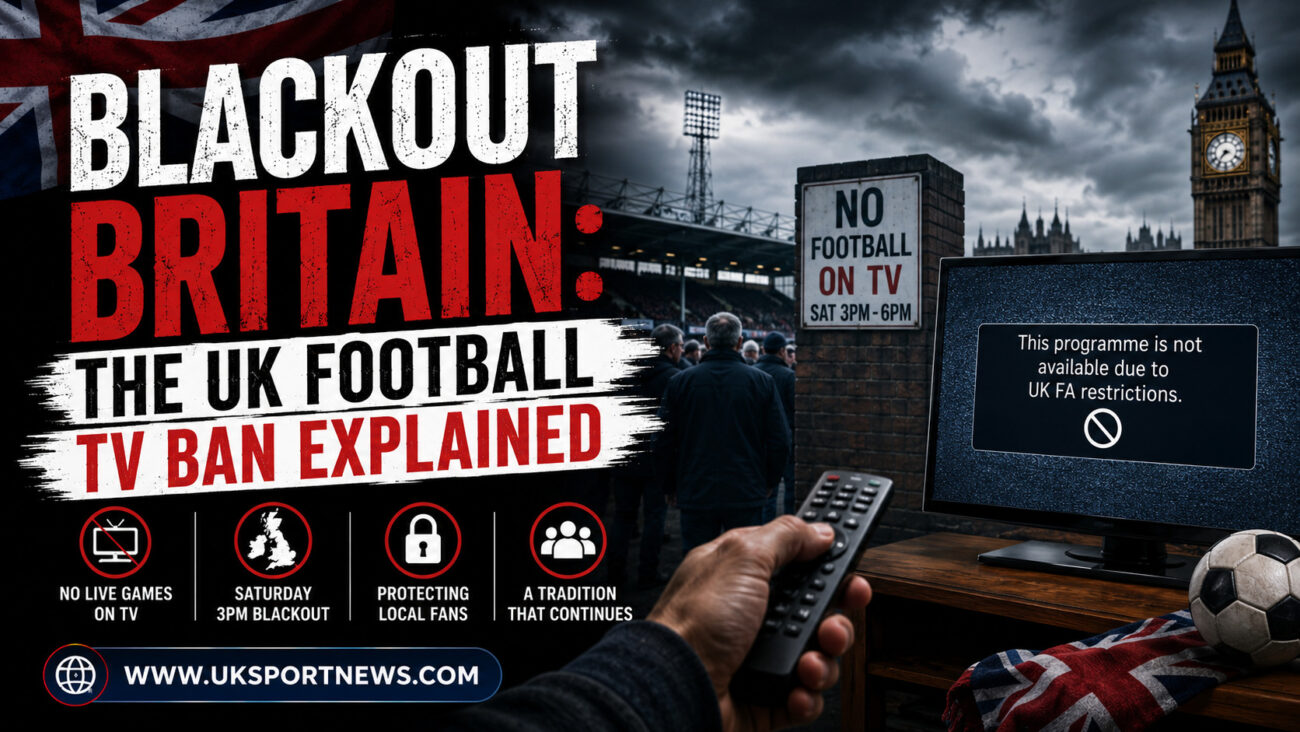
Somewhere in Manchester right now, a United fan can legally watch almost any football match in the world on television except the one kicking off three miles down the road at 3pm on a Saturday. A supporter in Madrid, Milan, or New York can watch that same Manchester United fixture live without any restriction at all. This is the UK football TV blackout, a rule now over sixty years old that continues to shape when and how the country is allowed to watch its most popular sport.
What the 3 pm Blackout Actually Does
The blackout rule prevents live football from being broadcast on UK television or streaming services between 2:45pm and 5:15pm on Saturdays. It applies whenever at least half of that weekend’s fixtures across the top two English divisions kick off at 3pm, and it covers the Premier League, the English Football League, the FA Cup, and their Scottish equivalents. Even foreign leagues such as La Liga and Serie A are affected, with UK broadcasters unable to show their Saturday 3pm kickoffs live during that window.
Radio commentary is unaffected, which is why Saturday afternoon football radio remains such a fixture of British life despite the television restriction sitting right alongside it.
The History Behind the Rule
The blackout dates back to the 1960s, introduced after Burnley chairman Bob Lord successfully argued that televised football would damage attendances at lower league clubs. His concern was straightforward. If fans could watch the biggest games from home for free, why would they pay to stand on a cold terrace watching their own struggling local side instead.
The rule was later formalised through UEFA’s Article 48, which grants national football associations the power to restrict live broadcasts during a fixed weekend window. Crucially, England and Scotland remain the only major European football nations that still make active use of that provision. France, Spain, Germany, and Italy all broadcast their domestic Saturday 3pm fixtures without restriction, and none of those leagues have reported the kind of attendance collapse the blackout was originally designed to prevent.
The rule has been suspended only once in the modern era, during the 2019-20 season, when matches were played behind closed doors during the Covid pandemic and every fixture needed to be televised simply because no fans could attend in person.
Why the Blackout Still Exists
Given the money now involved in English football, it might seem strange that a rule from the 1960s has survived into an era of billion pound broadcast deals. The explanation comes down to a mix of finances and tradition.
- Lower league survival: non-league and lower division clubs still rely heavily on matchday income, and many argue removing the blackout would hit attendances at exactly the clubs least able to absorb the loss.
- Broadcast deal protection: the Premier League’s current £6.7 billion television rights deal, agreed for the 2025 to 2029 cycle, explicitly protects the blackout, meaning it is contractually locked in regardless of public opinion until the deal is renegotiated.
- Tradition around the 3pm kickoff: many supporters, including those who never attend matches in person, see the protected 3pm slot as part of English football’s identity rather than simply an outdated broadcast restriction.
- Institutional inertia: Premier League chief executive Richard Masters confirmed in October 2025 that the league remains committed to the rule for the foreseeable future, giving broadcasters and clubs little immediate incentive to push for change.
The Case Against the Blackout
Opposition to the rule has grown louder as the cost of attending matches in person keeps climbing, and as streaming technology makes the restriction feel increasingly difficult to enforce. Fans who cannot get to games, whether for cost, distance, or accessibility reasons, are left with no legal way to watch their own team play during that Saturday window.
That gap has fuelled a genuine piracy problem. Reporting has suggested that almost five million people in the UK consumed pirated sports coverage over a recent six month period, a figure that critics argue undermines the blackout’s own stated goal of protecting the football industry’s finances. Removing the restriction, the argument goes, would give fans a legal viewing option and reduce the incentive to use illegal streams altogether.
Think of the blackout like an old shop policy that only accepts cash, long after every other business switched to card payments. The original logic made sense in its era, but the surrounding environment has changed so much that the rule now creates more friction than it solves.
Could the Blackout Ever Be Scrapped?
Talks between the Premier League and the English Football League over potentially reforming the blackout have reportedly taken place, marking the first time such discussions have been seriously floated. Even so, the current broadcast contracts lock the rule in place until at least 2029, when the next rights cycle comes up for negotiation.
Any change is likely to hinge on whether lower league clubs can be convinced their gate receipts would survive without the protection, a question nobody has been willing to test given how much financial risk it would represent for clubs already operating on tight margins.
Frequently Asked Questions
What is the 3pm football blackout in the UK?
The 3pm blackout is a rule preventing live football from being broadcast on UK television between 2:45pm and 5:15pm on Saturdays, applying whenever at least half of that weekend’s top two division fixtures kick off at 3pm.
Why was the football TV blackout introduced?
The rule was introduced in the 1960s after Burnley chairman Bob Lord argued that live television coverage of top matches would reduce attendances at lower league football clubs.
Do other countries have a football TV blackout?
No major European football nation apart from England and Scotland currently enforces this kind of blackout, even though UEFA’s Article 48 gives every national association the option to do so.
Will the UK football blackout be scrapped?
The Premier League’s broadcast deal for 2025 to 2029 protects the blackout for now, though reported talks between the Premier League and EFL suggest reform could be considered when that deal is renegotiated.
