
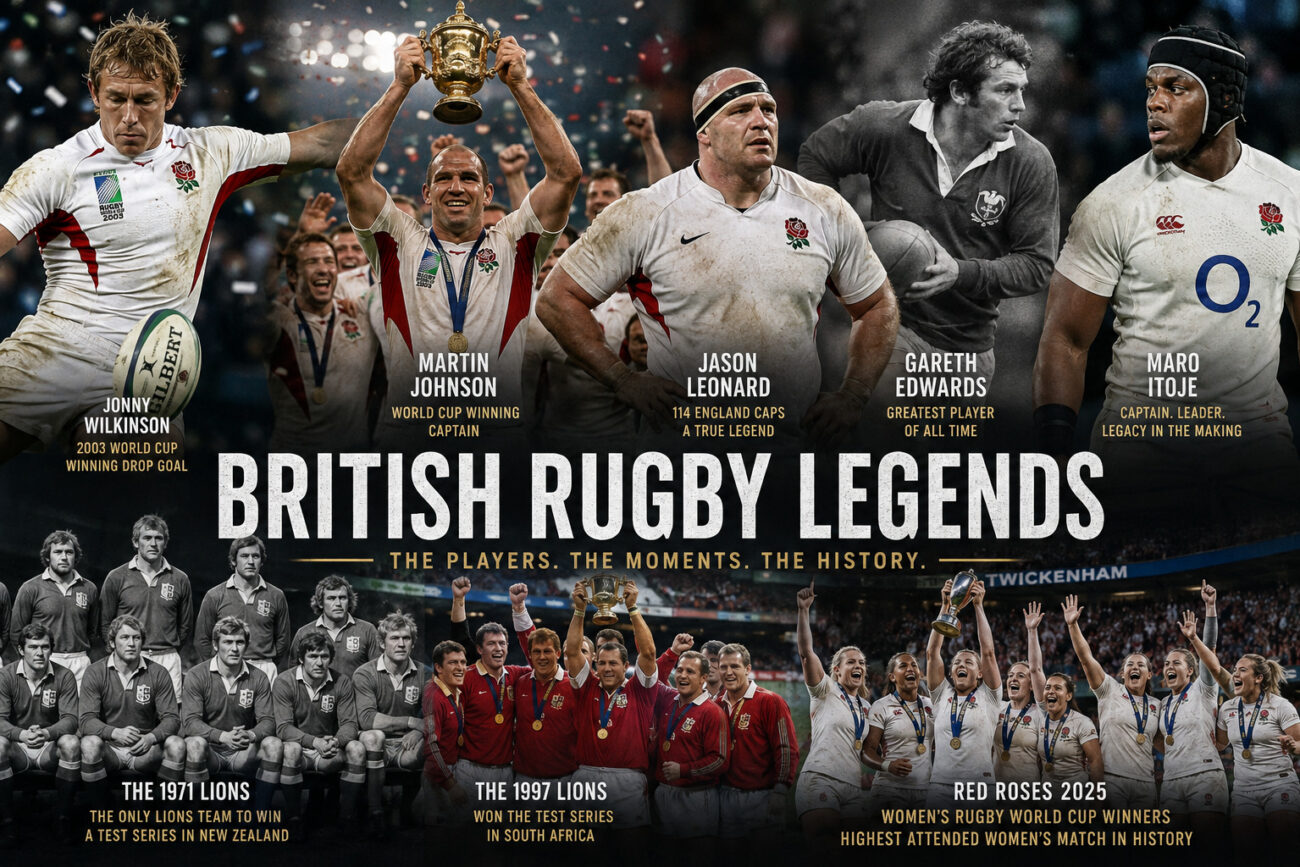
Twenty-six seconds. That’s how much time was left on the clock when Jonny Wilkinson dropped the goal that won England the 2003 Rugby World Cup. It remains the single most famous moment in British rugby history, but it’s far from the only one. From Welsh scrum-half wizardry in the 1970s to a prop who won more England caps than anyone in the game’s history, these are the British rugby players who changed the sport forever.
Jonny Wilkinson: The Drop Goal Heard Around the World
On 22 November 2003, with the World Cup final tied at 17-17 in extra time against Australia, Wilkinson received the ball from scrum-half Matt Dawson and slotted a right-footed drop goal to win the match 20-17. It made England the first northern hemisphere side ever to win the Rugby World Cup and turned Wilkinson into English rugby’s first true global superstar.
Wilkinson had already been voted international player of the year twice running by the time of that final, and remains England’s all-time record points scorer. That single kick, though, is the moment that’s replayed every time the tournament comes back around.
Martin Johnson: The Captain Who Lifted the Cup
Standing behind Wilkinson’s kick was Martin Johnson, the England captain whose carry in the build-up helped create the space for the winning drop goal. Johnson became the first England captain ever to lift the Rugby World Cup, capping a career built on sheer physical dominance in the second row and a leadership style built more on example than words.
Johnson’s influence extended well beyond that final. He later returned to English rugby as head coach, and his standing within the game remained such that decades on, players and pundits still reference “Johnno lifting the trophy” as one of the sport’s defining images.
Jason Leonard: England’s Most-Capped Player
Jason Leonard’s rugby story started at Barking RFC and ended with him as one of the most capped players the sport has ever seen. Nicknamed “the Fun Bus,” Leonard won 114 caps for England between 1990 and 2004, becoming the first British player ever to reach 100 international caps and finishing his career as the world’s most-capped player in the sport at the time.
Leonard won four England Grand Slams and was part of the victorious 2003 World Cup squad, coming on as a replacement in the final itself. He also toured with the British & Irish Lions three times, adding another five caps to his tally, and his versatility — equally comfortable on either side of the scrum — made him one of the most durable forwards English rugby has produced.
Gareth Edwards: Named the Greatest of All Time
No list of British rugby history is complete without Gareth Edwards, the Welsh scrum-half often described as the greatest player the sport has ever produced. In a 2003 poll of international players conducted by Rugby World magazine, Edwards was named the greatest player of all time, a verdict that’s rarely been seriously challenged since.
Edwards won 53 consecutive caps for Wales between 1967 and 1978, helping the national team claim seven Five Nations titles including three Grand Slams. He was part of the legendary 1971 British & Irish Lions side that beat New Zealand in a Test series for the first time ever, and he started every Test on the unbeaten 1974 Lions tour of South Africa as well. His try for the Barbarians against the All Blacks in 1973 is still simply known as “that try” — widely regarded as the greatest individual score in rugby union history.
The 1971 Lions: A Feat Never Repeated
The 1971 British & Irish Lions tour of New Zealand deserves its own place in this history. Featuring Edwards alongside a back line that included Barry John, JPR Williams, Gerald Davies, and Mike Gibson, the Lions won a Test series against the All Blacks in New Zealand — a feat that, remarkably, has never been repeated since. Former All Blacks captain Colin Meads later admitted his side struggled to understand exactly how the Lions had managed to keep them at bay.
That squad is still talked about as arguably the greatest touring side rugby has ever assembled, and it set a standard for Lions rugby that every subsequent tour gets measured against.
The Red Roses: Making History at Twickenham
British rugby history isn’t only a men’s story. In 2025, England’s women’s team, the Red Roses, won the Rugby World Cup final against Canada at Twickenham in front of a sell-out crowd. That match became the highest-attended women’s rugby match in history, played on the very same turf where Wilkinson’s drop goal had won the men’s tournament more than two decades earlier.
It’s a fitting symmetry for a stadium that’s hosted two men’s World Cup finals as well, and it marks one of the clearest signs yet of how far the women’s game has grown within British rugby’s broader story.
Maro Itoje: Captaining a New Era
More recently, Maro Itoje has become one of the defining figures of the modern British game, captaining England through recent Six Nations campaigns and standing as one of the most recognizable players in world rugby. His leadership has been tested through both triumph and adversity, including guiding England through a difficult 2026 Six Nations campaign that ended in their worst-ever finish in the tournament’s history.
Itoje represents a different kind of history-making than Wilkinson’s drop goal or Edwards’ try — the slower, ongoing work of shaping a team’s culture and identity across years rather than a single unforgettable moment. Whether his England side can add a World Cup or Six Nations title to his own legacy remains one of the more compelling storylines in the sport heading toward 2027.
Sir Gareth Edwards: A Legacy Recognized Beyond Rugby
Edwards’ standing in British sport was formally recognized well beyond the game itself. He was inducted into the International Rugby Hall of Fame among its first fifteen members, received a CBE in 2007 for services to sport, and was knighted in 2015 for his services to both sport and charity. Public polls in Wales have repeatedly crowned him the greatest Welsh player of all time, and his try for the Barbarians remains a fixture on lists of the greatest sporting moments in British history, not just rugby history specifically.
That level of recognition, stretching from playing fields in the 1970s to formal honors decades later, is part of what separates a great career from one that genuinely changes how a sport is remembered.
The 1997 Lions and a Different Kind of History
Jason Leonard’s career also intersected with another piece of Lions history. He was part of the British & Irish Lions squad that toured South Africa in 1997 and won the Test series against the Springboks, a tour still remembered for its physicality and for turning several of its players into genuine household names beyond rugby’s usual audience. Leonard’s ability to play both loosehead and tighthead prop made him a valuable squad member on that tour, just as it did throughout his England career.
Between the 1971 tour that Gareth Edwards played such a central role in and the 1997 tour Leonard featured on, the British & Irish Lions have provided some of the clearest examples in the sport of British and Irish players uniting to achieve something no individual nation could manage alone — a different, collective kind of sporting history-making that sits alongside the individual achievements on this list.
Key Takeaways
- Jonny Wilkinson: Scored the drop goal that won England the 2003 Rugby World Cup, the first northern hemisphere team to win the tournament.
- Martin Johnson: Became the first England captain to lift the Rugby World Cup, later returning as national head coach.
- Jason Leonard: Won 114 caps for England, still the most in the men’s team’s history, across four Grand Slams and a World Cup win.
- Gareth Edwards: Named the greatest rugby player of all time in a 2003 Rugby World magazine poll of international players.
- 1971 British & Irish Lions: Remain the only Lions team ever to win a Test series in New Zealand.
- Maro Itoje: A modern-era England captain whose leadership legacy is still being written.
FAQs
Who scored the winning drop goal in the 2003 Rugby World Cup final?
Jonny Wilkinson scored the winning drop goal with 26 seconds remaining in extra time, giving England a 20-17 win over Australia.
Who is considered the greatest rugby player of all time?
Welsh scrum-half Gareth Edwards was named the greatest player of all time in a 2003 poll of international players conducted by Rugby World magazine.
How many caps did Jason Leonard win for England?
Jason Leonard won 114 caps for England between 1990 and 2004, still the most in the men’s team’s history.
Have the British & Irish Lions ever won a series in New Zealand since 1971?
No, the 1971 Lions remain the only touring side to win a Test series against the All Blacks in New Zealand.
Who captains England rugby today?
Maro Itoje captains England, having led the team through recent Six Nations campaigns including the 2026 tournament.
Conclusion
From Wilkinson’s kick in Sydney to Gareth Edwards carving up defenses a generation earlier, British rugby history is full of moments that reshaped what the sport could be. These players didn’t just win games — they gave the sport its defining stories, the ones fans still tell decades later. Whoever writes the next chapter has a lot to live up to.
