
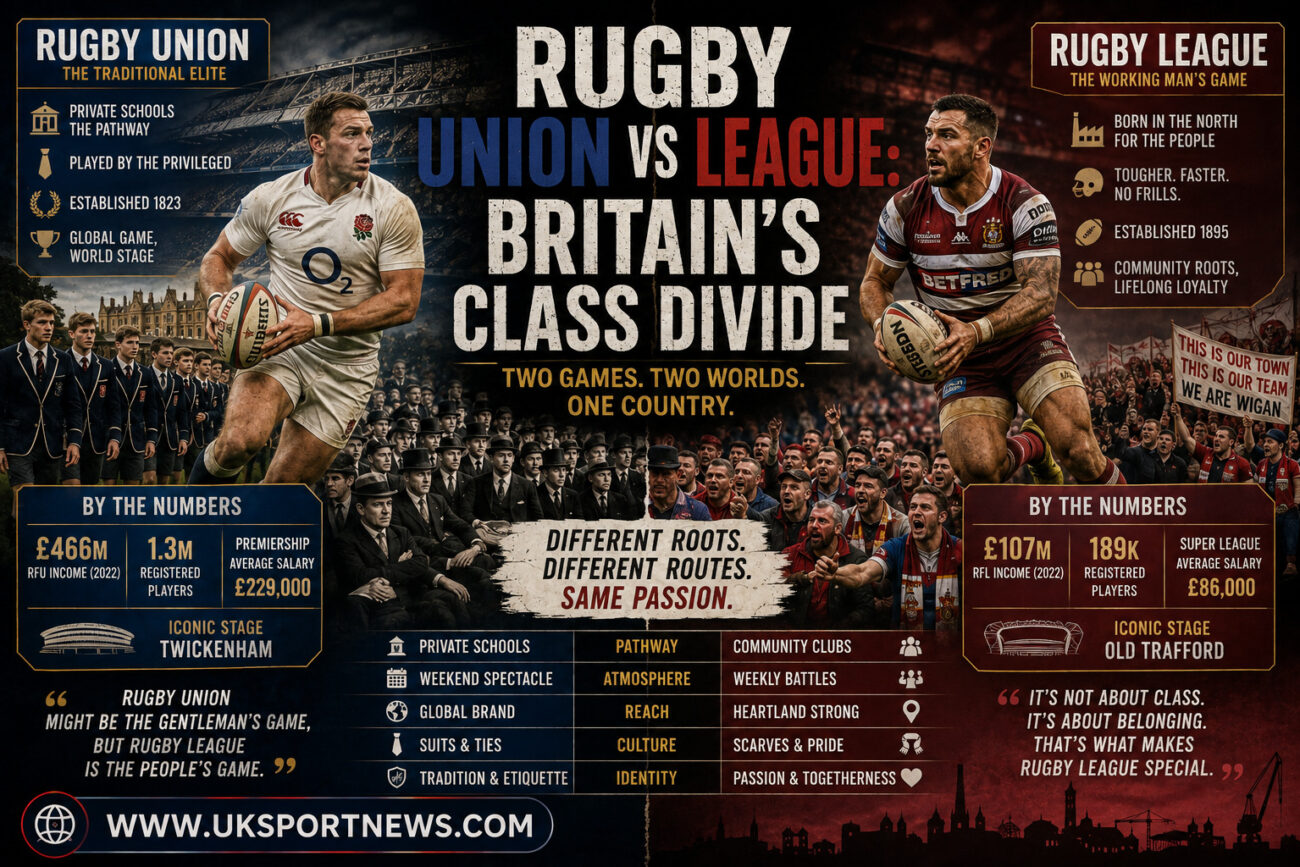
In 1895, twenty-two rugby clubs walked out of a meeting at the George Hotel in Huddersfield and formed a breakaway competition. That single afternoon split British rugby into two separate sports, and the fault line behind it was not really about rules. It was about class, money, and who got to call themselves an amateur.
Two Codes, One Sport, Completely Different Histories
Rugby union and rugby league share a common ancestor, but they have spent well over a century growing apart. Union became the game of English public schools, universities, and a largely amateur ethos that lasted deep into the twentieth century. League became the game of industrial northern England, built around working men who could not afford to play sport for free.
Understanding that split explains almost everything about how the two codes are still perceived today, from where their strongholds are on the map to who tends to play each one.
The Split That Started It All
The 1895 Meeting In Huddersfield
On 29 August 1895, representatives from clubs across Lancashire and Yorkshire met at the George Hotel and formed the Northern Rugby Football Union, breaking away from the Rugby Football Union that had governed the sport since 1871. The new organization would eventually become the Rugby Football League, and the sport it ran would develop its own identity as rugby league.
Broken Time Payments
The immediate trigger for the split was a dispute over what was called broken time payments. Working-class players in the industrial north often lost a day’s wages every time they missed a shift to play or travel to a match. Northern clubs wanted the right to compensate players for that lost income. The Rugby Football Union, dominated by wealthier southern clubs and former public schoolboys, refused, insisting the sport remain strictly amateur.
That refusal effectively told working-class players they could not afford to keep playing at a competitive level. The northern clubs broke away rather than accept it, and rugby league turned fully professional almost immediately, decades before rugby union would do the same.
How Geography Became Destiny
Northern Industrial Towns Built League From The Ground Up
Rugby league took root in the mill towns and mining communities of Lancashire and Yorkshire, places like Wigan, St Helens, Leeds, and Hull. These were towns built around manual labor, where a professional sporting wage genuinely mattered to players and their families. The sport became a source of local identity in a way that mirrored how football took hold in similar communities.
The Welsh Exception
Wales complicates the usual north versus south framing. Despite having plenty of working-class mining and industrial towns of its own, Wales largely stayed loyal to rugby union rather than switching to league, even though individual Welsh players regularly moved north to play professionally for English league clubs throughout the twentieth century. Rugby union became bound up with Welsh national identity in a way that made it far harder to dislodge, even among communities that shared the exact same economic conditions as their northern English counterparts.
A Century Of Amateurism Versus Professionalism
For roughly one hundred years after the 1895 split, rugby union clung to strict amateur rules, officially banning payments to players until the sport finally turned professional in 1995. Rugby league, by contrast, had been paying its players openly since the very year it was founded.
That century-long gap shaped how each sport was perceived. Rugby union carried an association with private education, university rugby, and a certain gentlemanly self-image. Rugby league carried an association with working-class grit and communities where sporting talent was treated as a legitimate route to a paycheck. A well-known old quip captured the stereotype bluntly: rugby union was seen as a hooligan’s game played by gentlemen, while rugby league was seen as a gentleman’s game played by hooligans.
Different Rules For Different Worlds
The two codes did not just diverge socially, they diverged on the pitch too. Over the decades following the split, rugby league moved toward a faster, more open style of play, while rugby union kept more of its traditional structure.
- Rugby league is played 13-a-side, a reduction from 15 introduced in 1906 to speed up the game.
- League uses a play-the-ball system after a tackle instead of union’s contested ruck, which keeps possession moving more quickly.
- League teams get six tackles to advance the ball before possession changes over, similar in spirit to a set of downs.
- Union retains scrums, lineouts, and rucks that create more stoppages and territorial battles for possession.
These rule differences were not accidental. They reflect two sports that developed separately for over a century, each shaped by the culture and priorities of the communities that sustained them.
The Class Divide Today
The old class lines have softened, but they have not disappeared. Rugby union’s Six Nations Championship remains the sport’s biggest showcase in Britain and Ireland, and France won the tournament again in 2026, beating England 48-46 in Paris on the final day to claim back to back titles. Union’s professional structure, its schools pathway, and its association with certain universities still carry echoes of its amateur, middle and upper class origins, even though the sport has become far more accessible than it once was.
Rugby league’s Super League, meanwhile, remains rooted almost entirely in the same towns that built the sport in 1895. Hull Kingston Rovers won the 2025 Super League Grand Final at Old Trafford, beating Wigan Warriors 24-6 to claim a historic treble and their first ever Super League title, becoming the first new champions in the competition since 2004. That kind of local, working-class heartland story is still very much the identity of the sport, even as league has expanded slightly beyond its traditional northern base.
Frequently Asked Questions About Rugby Union And Rugby League
Why did rugby union and rugby league split in 1895?
The split happened over a dispute about broken time payments, compensation for working-class players who lost wages while playing. The Rugby Football Union refused to allow this, leading northern clubs to break away and form what became rugby league.
When did rugby union become a professional sport?
Rugby union turned professional in 1995, exactly one hundred years after rugby league had already gone fully professional following the original 1895 split.
Why is rugby league mostly played in northern England?
Rugby league grew out of working-class industrial towns in Lancashire and Yorkshire, where players needed compensation for missed wages, something the amateur-only Rugby Football Union would not allow.
Why does Wales play rugby union instead of rugby league despite its industrial history?
Rugby union became closely tied to Welsh national identity, which kept the sport dominant even in working-class mining communities that shared similar economic conditions to rugby league’s northern English strongholds.
