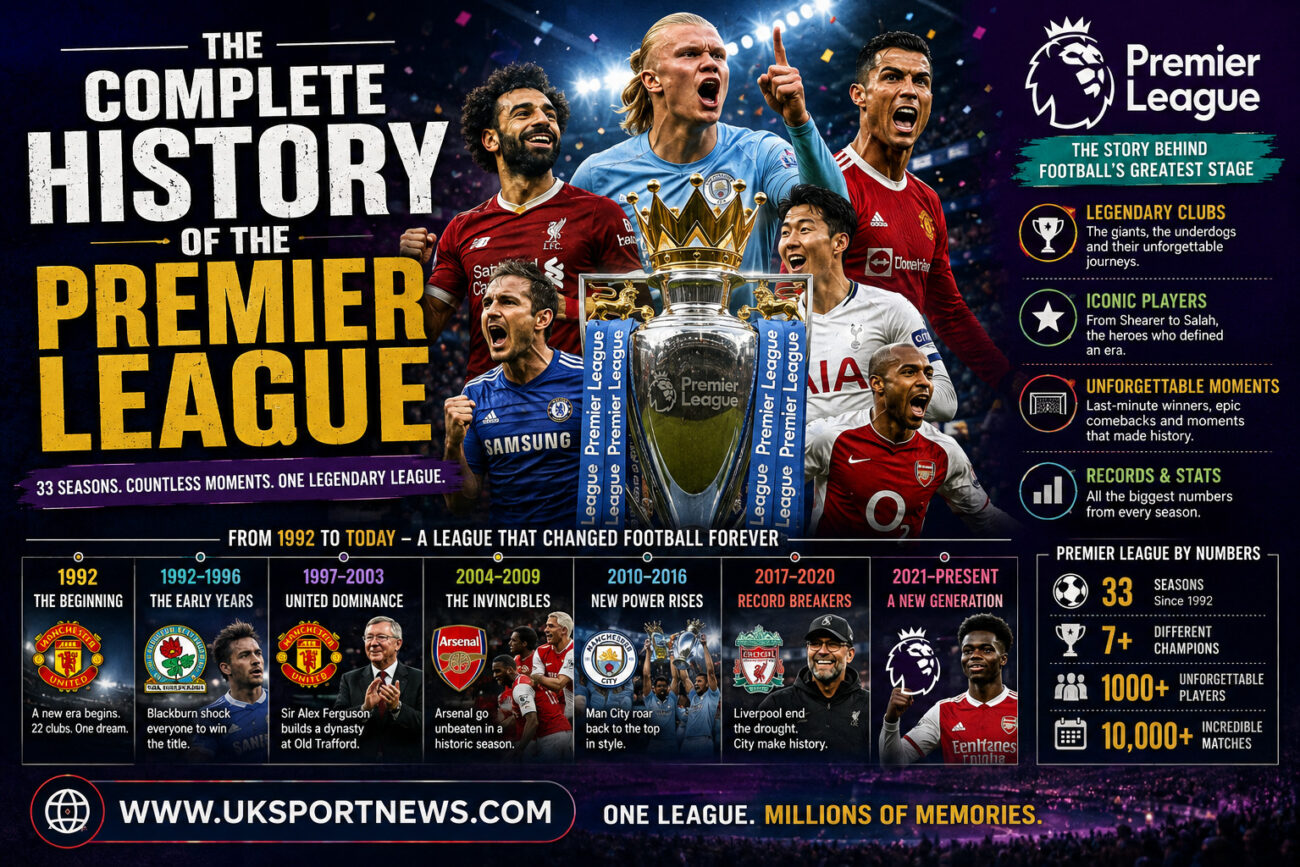
Thirty-four seasons, hundreds of billions of pounds in broadcast money, and a table topped by just seven different clubs. The history of the Premier League is really the story of English football stopping being a domestic competition and becoming a global business. Here’s the full story, from the breakaway in 1992 to Arsenal ending a 22-year wait for the title in 2026.
How it started
The Premier League wasn’t an evolution of the old First Division — it was a deliberate break. On 20 February 1992, the top clubs in English football split from the Football League to form their own competition, driven mostly by the promise of a much bigger TV deal with Sky.
That one decision reshaped English football’s finances almost overnight. Clubs in the new Premier League kept direct control of broadcast revenue instead of sharing it across the wider Football League pyramid. The first season kicked off in August 1992 with 22 clubs, trimmed down to the 20-club format still used today from 1995-96 onward.
Manchester United’s early years on top
Manchester United won the first Premier League title in 1992-93, finishing on 84 points under captain Bryan Robson — the club’s first English top-flight title in 26 years, and the start of a run that would define the competition’s first two decades.
Between 1992-93 and 2012-13, United won the title 13 times, all under Sir Alex Ferguson. Only Blackburn Rovers in 1994-95 and Arsenal, three separate times, broke the pattern. Ferguson rebuilt winning squads multiple times over two decades, which is a large part of why United still top the all-time title table with 13 championships.
When the money arrived
The league’s financial identity shifted hard in the early 2000s, and one takeover in particular changed the competitive landscape.
In 2003, Roman Abramovich bought Chelsea and started spending heavily on signings almost immediately. It paid off fast — back-to-back titles in 2004-05 and 2005-06 under Jose Mourinho, built on a defense that let in just 15 goals in that first title-winning season, still a Premier League record.
Manchester City went through something similar after Sheikh Mansour’s ownership group took over in 2008. It took a few years to turn into silverware, but City won their first Premier League title in 2011-12 in dramatic fashion — the start of a run that would eventually make them the second most successful club in the competition’s history.
Arsenal’s Invincibles and Leicester’s miracle
Not every big moment came from clubs with unlimited spending power.
Arsenal went through all of 2003-04 without losing a single match, the only club in Premier League history to finish a full season unbeaten. The run actually stretched to 49 matches across two seasons before finally ending in October 2004.
Leicester City’s 2015-16 title was the opposite of that kind of control — a club that had been fighting relegation the season before went on to win the league at bookmakers’ odds of roughly 5000-1, one of the biggest upsets in the history of any major sport.
City’s dynasty, and who stopped them
Under Pep Guardiola, Manchester City turned dominance into something close to routine. Between 2017-18 and 2023-24 they won six titles in eight seasons, including a 100-point campaign in 2017-18 that’s never been matched.
Liverpool broke that run twice — winning the title in 2019-20 to end a 30-year wait for their first Premier League championship, then again in 2024-25 with a rebuilt squad. Then came 2025-26, when Arsenal returned to the top under Mikel Arteta, finishing on 85 points for their first title since 2003-04, after spending 234 days at the top of the table over the course of the season.
Every Premier League champion
1992-93: Manchester United
1993-94: Manchester United
1994-95: Blackburn Rovers
1995-96: Manchester United
1996-97: Manchester United
1997-98: Arsenal
1998-99:Manchester United
1999-2000: Manchester United
2000-01: ManchesterUnited
2001-02: Arsenal
2002-03: Manchester United
2003-04: Arsenal
2004-05: Chelsea
2005-06: Chelsea
2006-07: Manchester United
2007-08: Manchester United
2008-09: Manchester United
2009-10: Chelsea
2010-11: Manchester United
2011-12: Manchester City
2012-13: Manchester United
2013-14: Manchester City
2014-15: Chelsea
2015-16: Leicester City
2016-17: Chelsea
2017-18: Manchester City
2018-19: Manchester City
2019-20: Liverpool
2020-21: Manchester City
2021-22: Manchester City
2022-23: Manchester City
2023-24: Manchester City
2024-25: Liverpool
2025-26: Arsenal
By title count: Manchester United (13), Manchester City (8), Chelsea (5), Arsenal (4), Liverpool (2), and one each for Blackburn Rovers and Leicester City.
How it went global
None of this happens without the broadcasting money. What started as a domestic Sky Sports deal in 1992 grew into a product shown in more countries than almost any other sports league on the planet, and that revenue is the real engine behind everything else here — record transfer fees, new stadiums, all of it.
It’s a bit like comparing a corner shop to a supermarket chain: the core product, football matches, hasn’t really changed. What changed is the scale of everything around it, and that scale is what let clubs compete for players and managers on a genuinely global stage.
FAQ
When was the Premier League founded? 20 February 1992, when the top-flight English clubs broke away from the Football League to negotiate their own broadcasting deals.
Which club has won the most Premier League titles? Manchester United, with 13 — all under Sir Alex Ferguson, between 1992-93 and 2012-13.
Has any club gone an entire season unbeaten? Yes. Arsenal in 2003-04, still the only club in Premier League history to manage it.
Who won the most recent title? Arsenal, in 2025-26, under Mikel Arteta — their first championship since 2003-04.
