
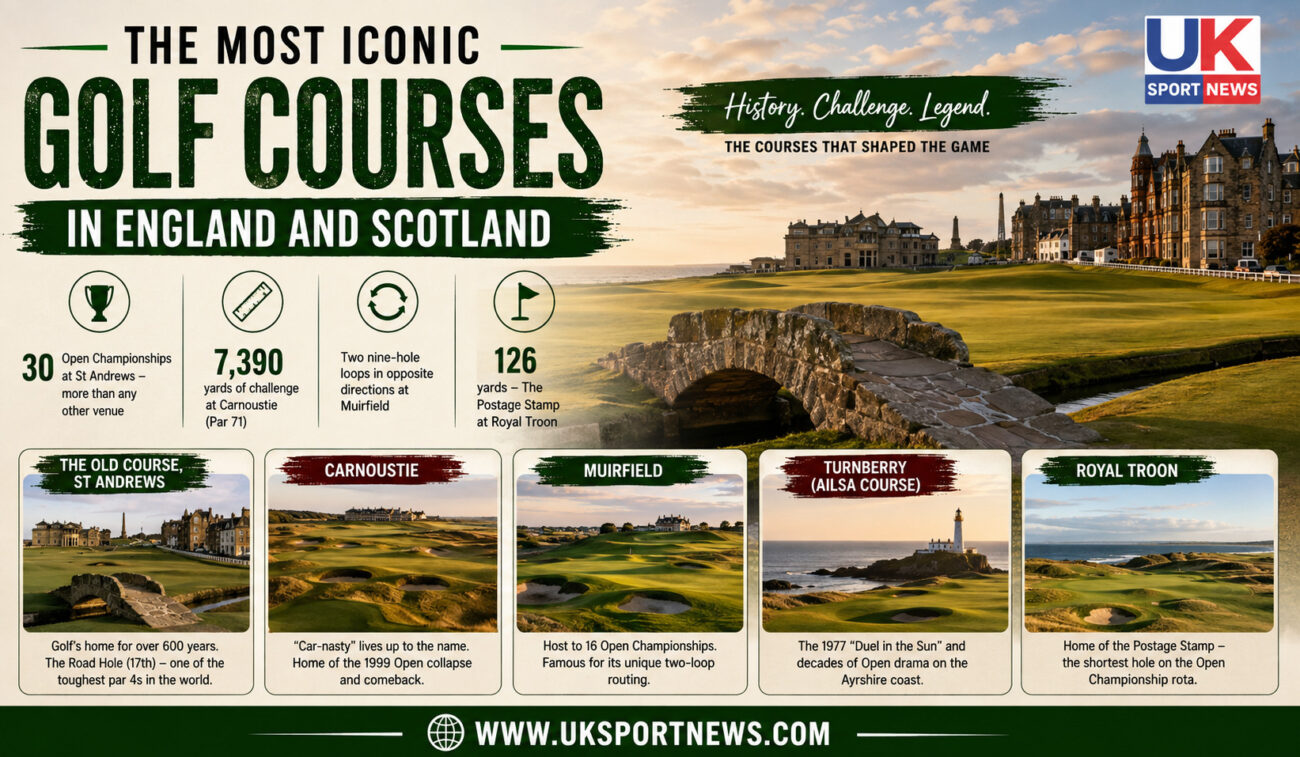
People have played golf on the same stretch of land at St Andrews since around 1400 AD. Six centuries later, that same ground still hosts the sport’s oldest championship. That’s the thread running through the most iconic golf courses in England and Scotland: history you can still walk, on holes that haven’t lost their bite.
The Old Course, St Andrews
The Old Course didn’t come from an architect’s drawing board. It formed over centuries of play, which is part of why it still confuses first-time visitors used to modern, symmetrical designs.
The Society of St Andrews Golfers, founded in 1754, reduced the course from 22 holes to 18 in 1764, creating the standard round used everywhere in the world today. The name “Old Course” only appeared in 1895, once the New Course opened next door and people needed a way to tell the two apart.
The Road Hole
The 17th hole, known as the Road Hole, regularly gets called the toughest par 4 in golf. The tee shot has to carry part of a hotel building, and anything that drifts right brings the Road Hole bunker and the actual road into play.
30 times is how often the Old Course has hosted the Open Championship, more than any other venue in the tournament’s history.
Carnoustie
Carnoustie has earned its nickname the hard way. Golfers in North America call it “Car-nasty,” and the course backs that reputation up at 7,390 yards and a par of 71.
The layout began as a 10-hole course designed by Allan Robertson and Old Tom Morris in 1842. Morris extended it to 18 holes in 1867, and James Braid’s redesign in 1926 set the routing still used today. The Barry Burn winds through the closing holes, turning the final stretch into one of the most nerve-testing finishes in golf.
The 1999 Collapse
The 18th hole produced one of the sport’s most famous meltdowns in 1999, when a double bogey would have won the Open outright and simply didn’t happen. Paul Lawrie went on to win the resulting three-way playoff, completing the biggest final-round comeback in major championship history.
Muirfield
Muirfield belongs to the Honourable Company of Edinburgh Golfers, the oldest golf club in existence and the group responsible for producing the first written Rules of Golf. The club sits in Gullane, East Lothian, on a course designed by Old Tom Morris.
Its layout is unusual by links standards: two loops of nine holes, one running clockwise and the other anticlockwise, rather than the typical out-and-back routing most seaside courses follow.
16 times is how often Muirfield has hosted the Open, most recently in 2013, when Phil Mickelson’s final-round charge made him only the second left-hander to win the championship. Nick Faldo’s late rally to victory in 1992 is remembered just as fondly.
Turnberry’s Ailsa Course
Turnberry sits directly on the Ayrshire coast, and its Ailsa Course is home to one of golf’s most legendary head-to-head battles. The 1977 “Duel in the Sun” between Tom Watson and Jack Nicklaus went the distance across the final two rounds, with Watson eventually winning by a single stroke.
Watson returned to the same course in 2009, chasing an improbable win at age 59, 26 years removed from his last major title. He lost a playoff to Stewart Cink, but the story only added to Turnberry’s reputation. Greg Norman and Nick Price have also won Opens there.
A Rare Distinction
Along with Royal Troon, Turnberry is one of only two Scottish Open venues that has never produced a homegrown Scottish winner, an odd footnote given how much Scottish golf history the course has witnessed.
Royal Troon
Royal Troon began in 1878, when 23 members split away from nearby Prestwick to form their own club. It’s grown into one of the sport’s most recognizable venues, hosting the Open Championship most recently in 2024.
Its signature hole isn’t a monster. The 126-yard par-3 8th, known as the Postage Stamp for its tiny target of a green, is the shortest hole anywhere on the Open rota, and missing it by even a few yards almost guarantees a dropped shot.
Key Takeaways
- Oldest course in the world: golf has been played at St Andrews since roughly 1400 AD.
- Most Open Championships hosted: the Old Course, with 30 editions.
- Toughest test by the numbers: Carnoustie stretches to 7,390 yards at par 71.
- Unusual routing: Muirfield runs as two separate nine-hole loops in opposite directions.
- Shortest hole on the rota: Royal Troon’s Postage Stamp, at just 126 yards.
FAQs
Which is the oldest golf course in the world?
The Old Course at St Andrews, where golf has been played since around 1400 AD.
Why is Carnoustie nicknamed “Car-nasty”?
Its length and the Barry Burn running through the closing holes make it one of the toughest tests in golf.
What is unusual about Muirfield’s layout?
It runs as two nine-hole loops in opposite directions, rather than a typical out-and-back links routing.
What happened at Turnberry in 1977?
Tom Watson beat Jack Nicklaus by one stroke in the famous “Duel in the Sun.”
What is the Postage Stamp?
Royal Troon’s 126-yard par-3 8th hole, the shortest hole on the Open Championship rota.
Conclusion
Each of these courses earned its reputation the same way: by testing the best players in the world and refusing to get any easier over time. From the Old Course’s ancient double greens to Turnberry’s coastal drama, the most iconic golf courses in England and Scotland remain must-visit ground for anyone serious about the game.
