
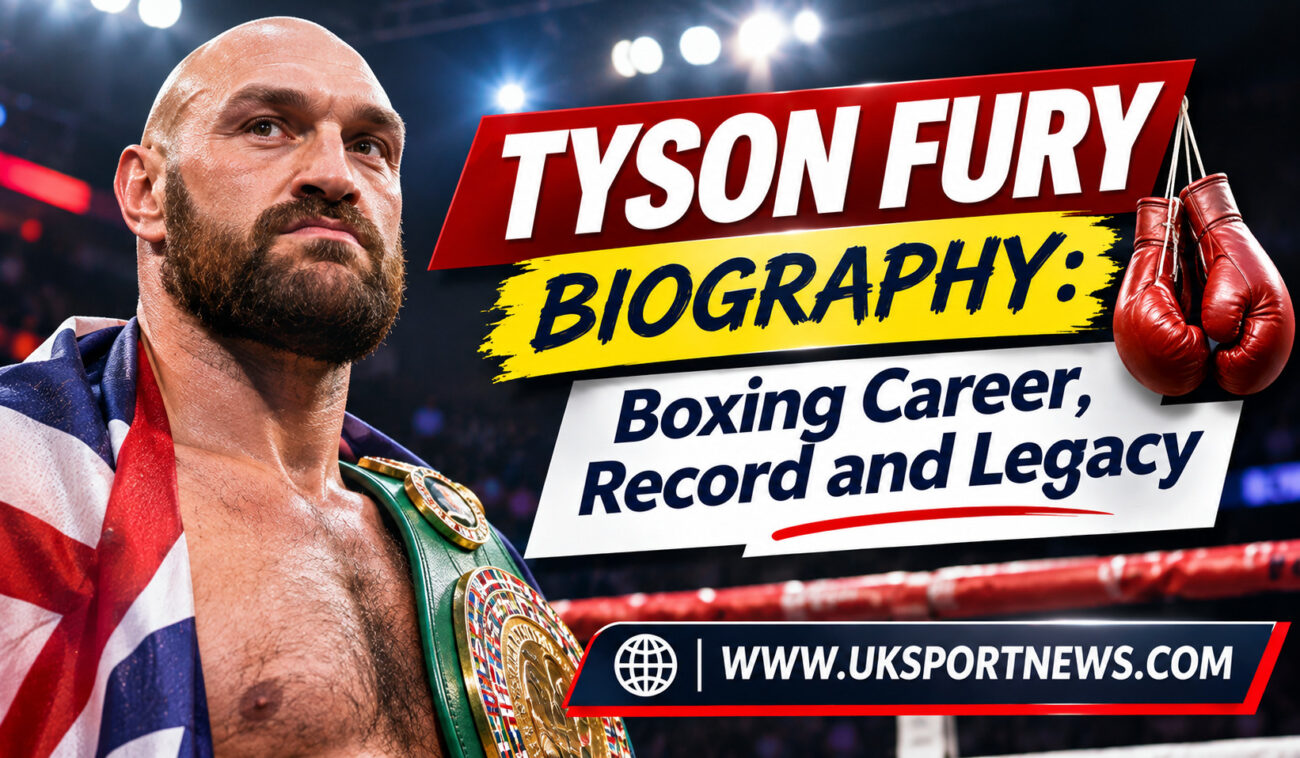
Düsseldorf, November 2015. Wladimir Klitschko had not lost a fight in eleven years. For the entire duration of that unbeaten run, the Ukrainian had dominated heavyweight boxing so completely that the division barely registered elsewhere. Then Tyson Fury arrived, danced, switched stance, disrupted the rhythm that had beaten everyone, and won every single round of a unanimous decision. It was one of the great upsets in modern heavyweight boxing. Fury had announced himself to the world — and then promptly disappeared from it for three years.
That disappearance, the depression and the weight gain and the personal chaos that followed, is as much a part of the Tyson Fury story as the boxing. So is the comeback. So are the multiple retirements that never seemed to stick. Born Tyson Luke Fury on 12 August 1988 in Manchester — six weeks prematurely, which his father John Fury later claimed shaped the boy’s fighting instinct from the very start — Fury grew up in a family deeply connected to the Traveller community and to boxing. His father John Fury was a professional fighter. The name Tyson was chosen in honour of Mike Tyson.
For more UK sport biography content, the Ben Stokes biography covers England’s greatest modern cricket all-rounder, the Andy Murray biography tells the story of three Grand Slams and two Olympic golds, and the Emma Raducanu biography follows the teenager who won a Grand Slam from qualifying and is still chasing more.
Early Career: The Unbeaten Record Builds
Fury made his professional debut on 6 December 2008 — two weeks after marrying Paris Mulroy, who would become one of the most important people in his story. He was fast. He was big at 6ft 9in with an 85-inch reach. He was also unusual: a heavyweight who moved, who changed stance, who talked endlessly, who disrupted opponents psychologically before the bell even rang.
His amateur career finished at 31 wins and 4 losses, including stints boxing under two different national flags. He turned professional and did not lose his first 35 fights. Along the way he beat Dereck Chisora three times — twice by knockout and once on a unanimous decision — and kept building toward a world title shot that felt increasingly inevitable.
The Klitschko fight in November 2015 was the destination. Fury won the WBA, IBF, WBO and lineal heavyweight titles on that night in Düsseldorf. He was the first British heavyweight world champion since Lennox Lewis. He should have been celebrating the start of a golden era. Instead, what followed was the lowest period of his life.
The Wilderness Years and the Mental Health Journey
Fury stripped the titles rather than fight Klitschko in an immediate rematch. He gained significant weight. He spoke publicly and repeatedly about depression, about dark thoughts, about a period where he felt unable to function properly. Those conversations were unusual for a professional athlete, especially a male heavyweight boxer, and they created a different kind of public connection with Fury — one that went beyond sport.
He returned to training in 2018. The comeback fight against Sefer Seferi in June 2018 was a low-key start, but the direction was clear. Then came the first fight with Deontay Wilder in December 2018 — the fight that produced one of the most discussed moments in recent boxing history. Fury was knocked down hard in the twelfth round and appeared to be finished. Instead, he rose, weathered the final seconds and the fight was declared a split draw. He had beaten the count from a position where it seemed impossible.
He beat Wilder in their rematch in February 2020, stopping the American in the seventh round in what was arguably the best performance of Fury’s career. A third fight followed in October 2021, with Fury winning by TKO in round 11 after being knocked down twice himself. Both men had hurt each other across three extraordinary fights, and Fury emerged from the trilogy as the clear winner.
The Usyk Fights and the Defeats
Oleksandr Usyk had unified the other heavyweight titles and a fight with Fury became the one fight that could genuinely crown an undisputed heavyweight champion. They met for the first time on 18 May 2024 in Riyadh. Fury lost on a split decision — his first professional defeat, and the one that cost him the WBC heavyweight title. The rematch on 21 December 2024 ended in a unanimous decision loss, making it two defeats to the same opponent in the same year.
On 13 January 2025, Fury announced his retirement for the fifth time. His record at that point had stood at 34 wins, 2 losses and 1 draw. The losses to Usyk were the first two defeats of his professional career, both coming in 2024. His only professional defeats have both come against one man — Oleksandr Usyk.
The 2026 Return: Yet Again
Retirement, again, did not stick. Fury announced his return in January 2026 on social media, and on 11 April 2026 he beat Arslanbek Makhmudov by unanimous decision over 12 rounds at Tottenham Hotspur Stadium in London, headlining a Netflix event. Three months later, on 24 July 2026, he stopped Mariusz Wach in round seven.
His record now stands at 36 wins, 2 losses and 1 draw, with 25 wins inside the distance across 39 professional fights. He is active. The Sunday Times Rich List in 2026 put his fortune at £162 million. He is scheduled to fight Anthony Joshua on 11 December 2026 at the Principality Stadium in Cardiff — an all-British heavyweight bout that has been talked about for over a decade and is finally confirmed.
The Joshua fight is the one British boxing fans have wanted for years. It is the biggest all-British heavyweight fight ever staged. Fury takes it as the older man, without the world titles and off the back of two defeats — but nobody who has followed his career would bet against him finding a way to make it his night.
Family and Character
Fury and Paris have seven children and have been married since November 2008, two weeks before his professional debut. Paris Fury has become a prominent public figure in her own right, and their family life — with its combination of Traveller tradition and the demands of professional boxing — has been documented widely.
The character Fury projects inside and outside the ring has made him one of the more divisive and compelling figures in British sport. He talks constantly, performs theatrically, has sung in the ring after fights, and approached the entire business of professional boxing with a showman’s sense of what an audience wants. Behind it lies a boxer of real technical quality — underrated as a craftsman because the personality is so loud.
His courage when the fight demanded it — climbing off the canvas against Wilder in round twelve of their first fight, competing for more than three years after the hip and body issues that accompanied his wilderness period — is not in question.
Career Highlights
- Professional record: 36-2-1 (25 KOs) across 39 fights
- First world title win: Wladimir Klitschko, November 2015 (WBA, IBF, WBO, lineal)
- WBC title win: Deontay Wilder rematch, February 2020
- Only professional losses: Both to Oleksandr Usyk, in May and December 2024
- Only professional draw: Deontay Wilder, December 2018
- Height: 6ft 9in (206cm)
- Reach: 85 inches
- Professional debut: 6 December 2008
- Sunday Times estimated net worth (2026): £162 million
- Next fight: Anthony Joshua, 11 December 2026, Principality Stadium, Cardiff
FAQs
What is Tyson Fury’s professional boxing record? Fury’s record stands at 36 wins, 2 losses and 1 draw, with 25 wins by knockout or stoppage, across 39 professional fights.
Who has beaten Tyson Fury? Fury’s only professional defeats both came against Oleksandr Usyk — a split decision in May 2024 and a unanimous decision in December 2024.
When did Tyson Fury beat Wladimir Klitschko? Fury defeated Klitschko by unanimous decision in November 2015 in Düsseldorf, winning the WBA, IBF, WBO and lineal heavyweight titles.
Is Tyson Fury retired? No — Fury returned to professional boxing in April 2026 after announcing his fifth retirement in January 2025, and is scheduled to fight Anthony Joshua on 11 December 2026.
When and where is Fury vs Joshua? Tyson Fury faces Anthony Joshua on 11 December 2026 at the Principality Stadium, Cardiff, in the biggest all-British heavyweight fight ever staged.
Conclusion
The Tyson Fury biography is a story that refuses to end neatly. Boxing career, record and legacy — all three are still being written. He beat Klitschko when nobody thought he could. He came back from personal crisis when the sport assumed he was finished. He climbed off the canvas against Wilder in one of boxing’s most iconic moments. He lost twice to Usyk, retired, and came back. The Joshua fight in December 2026 is the next chapter. Whatever the result, Fury has already made himself one of the most significant British heavyweight boxers in the sport’s history.
