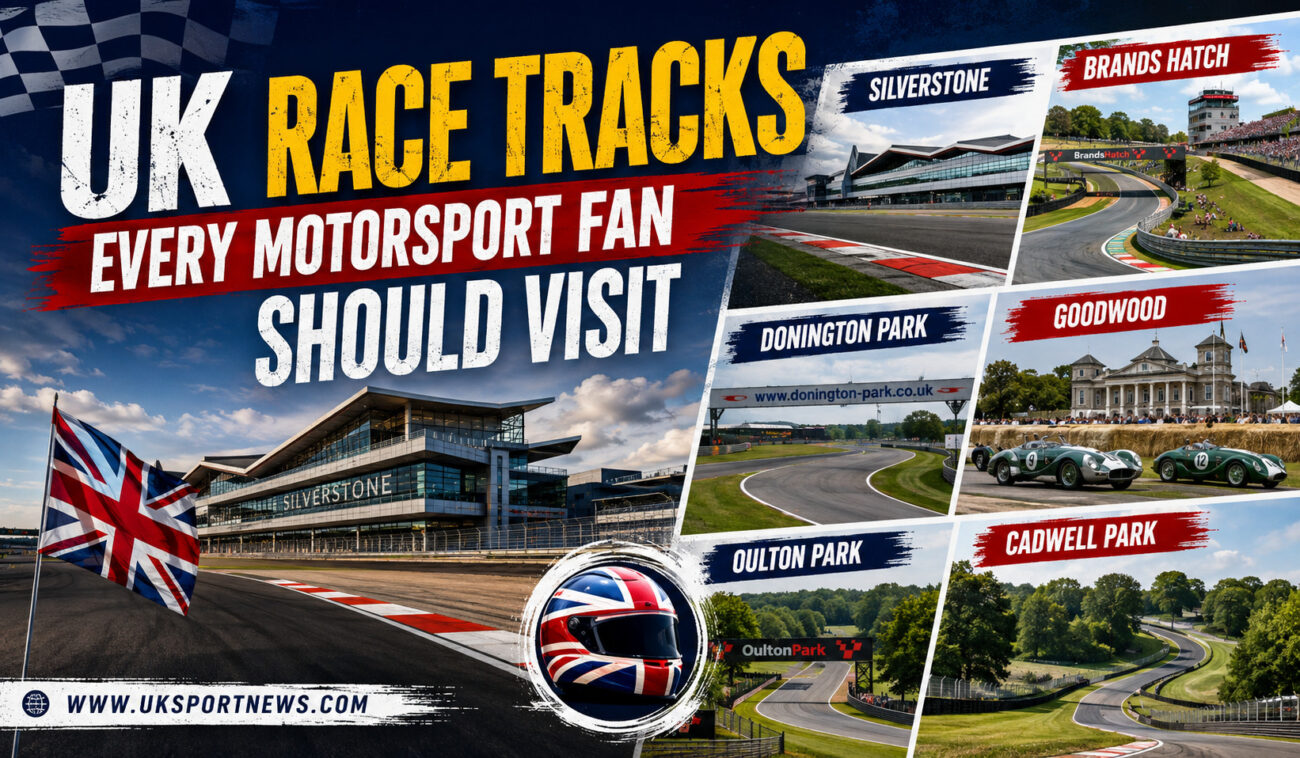
Silverstone alone has hosted the British Grand Prix 58 times since 1950. Add Brands Hatch, Donington, Goodwood, Oulton Park, and Cadwell Park to the mix, and you get a country with more motorsport history packed into it than almost anywhere else on earth. If you’re planning a trip built around UK race tracks, you’ve got some serious ground to cover — and some serious stories waiting at every corner.
This isn’t a list of car parks with tarmac stuck to them. Each of these circuits has hosted a moment that racing fans still argue about decades later. Here’s where to go, what happened there, and why it still matters.
Silverstone: The Home of British Motorsport
Silverstone opened in 1948 on a former RAF bomber base, and it’s been the beating heart of British racing ever since. It hosted the first-ever round of the Formula One World Championship in 1950, and it’s been on the calendar almost every year since.
Silverstone has held the British Grand Prix on 58 occasions. That number keeps climbing — Lewis Hamilton alone has won there nine times, more than any other driver in the race’s history.
A Track That Keeps Changing
The current Grand Prix layout runs 5.891 km with 18 corners, a long way from the featureless airfield circuit of the late 1940s. Silverstone shared British Grand Prix duties with Aintree through the 1950s and alternated with Brands Hatch from 1963 to 1986. Since 1987, it’s had the race to itself, and the circuit now holds around 164,000 fans on race weekend.
Hamilton’s dominance at the track is hard to overstate. He won four British Grands Prix in a row between 2014 and 2017, one of only eight drivers to string together back-to-back victories at Silverstone. British drivers as a whole have won here far more often than any other nationality, which says a lot about what this circuit means to the sport at home.
Brands Hatch: Kent’s Grand Prix Battleground
Before it was a racing circuit, Brands Hatch was a dirt track carved out of farmland for motorcycles in the 1920s. Cars didn’t race there properly until 1950, but once they did, the place built a reputation fast.
Between 1964 and 1986, Brands Hatch hosted the British Grand Prix 12 times, sharing the honor with Silverstone. It also staged two European Grands Prix, including Nigel Mansell’s breakthrough first F1 win in 1985.
Its final Grand Prix came in 1986, when a multi-car pile-up left Jacques Laffite with two broken legs and ended his career. Formula One never came back. Today the circuit hosts the British Touring Car Championship, British Superbikes, and the Formula Ford Festival on a shortened Grand Prix layout of 3.916 km.
Donington Park: Where Senna’s Legend Grew
Donington Park in Leicestershire claims a genuine first: it was the first permanent park circuit built in England, opening as a motorcycle track in 1931 before cars followed two years later. Between 1935 and 1938, it hosted the Donington Grand Prix, drawing the dominant German teams of the era — Auto Union and Mercedes-Benz — with Tazio Nuvolari and Bernd Rosemeyer among the winners.
The circuit sat dormant after the war until Tom Wheatcroft bought the land in 1971 and reopened it in 1977, later building a museum around the largest collection of single-seater racing cars in the world. That kind of long memory is part of what makes Donington feel different from a lot of other circuits — the museum sits right there on site, so you can walk from the cars in the display halls to the corners they actually raced on.
Donington’s one shot at hosting a Formula One World Championship race came in 1993, with the European Grand Prix. Ayrton Senna carved through the field on a soaking wet opening lap to take the lead, then went on to win by well over a minute. It remains the only F1 World Championship race the track has ever held, though it hosted the British motorcycle Grand Prix regularly from 1987 to 2009.
Goodwood: Racing Frozen in Time
Goodwood Motor Circuit sits on the site of RAF Westhampnett, a wartime airfield that hosted fighter squadrons during the Battle of Britain. Freddie March, the 9th Duke of Richmond, opened the track for racing in September 1948, and for nearly two decades it drew the biggest names in the sport — Fangio, Moss, Clark, Hill.
Racing at the circuit stopped in 1966. It stayed quiet for over 30 years until the Duke’s grandson revived it in 1998 with the Goodwood Revival, a race meeting where competitors and spectators dress in period clothing to match the cars.
Confusingly, the Festival of Speed is a separate event entirely. Launched in 1993, it takes place on a 1.16-mile hillclimb through the grounds of Goodwood House, not on the circuit itself. The circuit today measures 3.862 km with nine corners.
Oulton Park: The Parkland Circuit
Oulton Park sits on the site of a former country estate near Little Budworth in Cheshire, and the track’s layout still winds through what used to be parkland. It opened in August 1953 and grew several times over its first decade before settling near its current shape.
From 1954 into the 1970s, Oulton Park held the International Gold Cup, a non-championship Formula One race that pulled in drivers like Stirling Moss, Jack Brabham, and John Surtees. The current International Circuit runs 2.676 miles with 17 corners, known for sharp elevation changes and blind crests through corners with names like Cascades and Knickerbrook.
It’s still a fixture on the modern calendar, hosting the British Touring Car Championship, British Superbikes, and British GT racing every year. The historic meeting built around the old Gold Cup name has picked up its own reputation too, drawing enough classic and vintage machinery that people around the paddock have started calling it “the Goodwood Revival of the North.”
Cadwell Park: The Mini-Nürburgring
Cadwell Park in Lincolnshire started life in 1934 as a three-quarter-mile track on land belonging to the Wilkinson family. It grew in stages — first in 1938, again in 1953, and once more in 1962 when it reached close to its current shape.
The track is narrow, hilly, and unapologetically old-school, which is exactly why bike racing fans love it. Its signature feature is The Mountain, a steep section where motorcycles get thrown into the air over the crest. That reputation has earned Cadwell the nickname “mini-Nürburgring,” and it’s the highlight venue every August for the British Superbike Championship. The Full Circuit measures 2.176 miles across 18 corners.
Cadwell’s narrow width is also why you won’t see top-level car racing there anymore — the track was built for motorcycles first, and it shows. For decades the circuit was owned by Grovewood Securities, the same company that once owned Brands Hatch and Oulton Park, which explains why several of these tracks share a bit of family history along with their corners.
Planning Your Trip
A few things are worth knowing before you set off chasing these circuits.
- Check the calendar first. Track days, club racing, and headline events like BSB or BTCC weekends change what you’ll actually see on arrival.
- Some circuits limit spectator access outside race weekends. Goodwood’s Motor Circuit, for instance, isn’t generally open to the public the way a museum would be.
- Distances between tracks add up fast. Brands Hatch and Donington are roughly two hours apart by road, and Cadwell Park sits well off to the east in Lincolnshire.
- Book accommodation early for headline events. Silverstone’s British Grand Prix weekend and Goodwood’s Revival both draw crowds well into six figures.
Key Takeaways
- Silverstone: Hosted the British Grand Prix 58 times, with Lewis Hamilton the most successful driver there at nine wins.
- Brands Hatch: Staged 12 British Grands Prix between 1964 and 1986, including Nigel Mansell’s first F1 win.
- Donington Park: The only UK circuit besides Silverstone and Brands Hatch to host a Formula One World Championship race, in 1993.
- Goodwood: Closed to racing for over 30 years before reviving in 1998 with the period-dress Goodwood Revival.
- Oulton Park: Built on former parkland and once hosted non-championship F1 races through the International Gold Cup.
- Cadwell Park: Nicknamed the mini-Nürburgring for its narrow, hilly layout and famous Mountain section.
FAQs
Which UK race track has hosted the British Grand Prix the most times?
Silverstone holds that record, having staged the British Grand Prix 58 times since 1950.
Can the public drive around Goodwood Motor Circuit?
Goodwood’s circuit is primarily used for organized events like the Revival and Members’ Meeting rather than general public track days.
What is the Goodwood Festival of Speed, and is it the same as the Revival?
The Festival of Speed is a separate hillclimb event held on the grounds of Goodwood House, while the Revival is the period-dress race meeting held on the Motor Circuit itself.
Why did Brands Hatch stop hosting the British Grand Prix?
Formula One left Brands Hatch after 1986 as the circuit struggled to meet the growing safety and space demands of modern Grand Prix racing.
What makes Cadwell Park different from the UK’s bigger circuits?
Cadwell Park is narrower and hillier than most UK circuits, built around a steep section called The Mountain that has earned it the nickname “mini-Nürburgring.”
Conclusion
Every one of these UK race tracks tells a different chapter of the same story — a country that’s been obsessed with motorsport since the years right after the Second World War, and never really got over it. Whether you’re chasing Formula One history at Silverstone, the old-school character of Cadwell Park, or the time-capsule feel of Goodwood, there’s enough here to build a road trip that could take weeks. Start with whichever story pulled you in the most, and go stand where it happened.
