Every April, roughly 70,000 people pack into Aintree to watch 34 horses jump 30 fences across two circuits, and millions more watch from home. That’s just one weekend on a packed British racing calendar. If you’re picking horse racing events in the UK to attend in person, you’ve got months of options, from muddy jump meetings in March to a five-day garden party on the South Downs in July. Here’s where to start.
Cheltenham Festival: The Toughest Ticket in Jump Racing
Held every March at Prestbury Park in Gloucestershire, the Cheltenham Festival runs four days and 28 races, with one championship race headlining each day. Tuesday belongs to the Champion Hurdle, Wednesday to the Queen Mother Champion Chase, Thursday to the Stayers’ Hurdle, and Friday to the big one: the Cheltenham Gold Cup.
The atmosphere is unlike anything else in racing. Irish fans travel in huge numbers, and the roar that greets the first race of the week, nicknamed “the Cheltenham Roar,” is genuinely startling if you’ve never heard it before.
Recent Festivals have drawn crowds in excess of 260,000 across the four days. If you go, book accommodation early. Cheltenham fills up fast.
The Grand National Festival at Aintree
The Grand National itself runs on the Saturday of a three-day meeting at Aintree, near Liverpool, usually in early April. It’s the race most non-racing fans know by name, a four-and-a-quarter-mile chase over 30 fences including the notorious Becher’s Brook.
Recent safety reforms have reshaped the race. The field was cut from 40 to a maximum of 34 runners starting in 2024, the first fence was moved closer to the start, and horses now begin from a standing start rather than walking to the tape.
You don’t need to love jump racing to enjoy Ladies’ Day on the Friday or National day itself. Expect big crowds, big hats, and a genuinely electric finish.
Royal Ascot: History, Hats, and the Royal Procession
Royal Ascot runs for five days every June and traces its roots back to 1711, when Queen Anne spotted a patch of heath near Windsor Castle that looked, in her words, ideal for horses to gallop at full stretch. The first race that year, Her Majesty’s Plate, had seven runners and a purse of 100 guineas.
Today it’s five days, several Group 1 races, and a strict dress code in the Royal Enclosure that dates back to rules set by Beau Brummell in the early 1800s. The Royal Procession, a horse-drawn carriage parade started by King George IV in 1825, still opens each afternoon.
Wednesday’s Gold Cup, first run in 1807, remains the meeting’s most prestigious race and gives Ladies’ Day its name.
Epsom Derby: The Original
The Derby has been run at Epsom Downs since 1780, and its name has been borrowed for more than 140 other races worldwide, including the Kentucky Derby. Legend has it the race got its name from a coin toss between the 12th Earl of Derby and Sir Charles Bunbury after a celebration for the Oaks, a fillies’ race Derby had launched the year before.
Run over a mile and a half on the first Saturday in June, the Derby is famous for Tattenham Corner, a sharp downhill turn into the home straight that has decided plenty of races before the finish line is even in sight.
It’s free to watch from the Downs if you don’t fancy paying for a grandstand seat, which makes it one of the more accessible big days on the calendar.
Glorious Goodwood: Racing With a View
Glorious Goodwood runs for five days at the end of July on the Goodwood Estate in West Sussex, a course the 3rd Duke of Richmond opened to the public in 1802. King Edward VII, a regular, once called it “a garden party with racing tacked on,” and the description still fits.
The setting does a lot of the work. The course sits high on the South Downs with views out toward the English Channel, and races like the Sussex Stakes (first run in 1841) and the Goodwood Cup (1812) draw some of the best milers and stayers in Europe.
More than 100,000 people attend across the five days most years.
The Ebor Festival at York
York’s big August meeting takes its name from Eboracum, the Roman name for the city, and dates back to 1843 with the first running of the Ebor Handicap. Racing itself has taken place on the Knavesmire, York’s current course, since 1730.
Over four days, the festival features the Juddmonte International, the Yorkshire Oaks, the Nunthorpe Stakes, and the Ebor Handicap itself, now one of the most valuable handicaps in Europe. The Knavesmire’s wide, galloping layout and long home straight make it a favorite among trainers and racegoers alike.
It’s often described as the best flat racing of the summer outside Royal Ascot, and it comes with the bonus of a day exploring York itself.
Key Takeaways
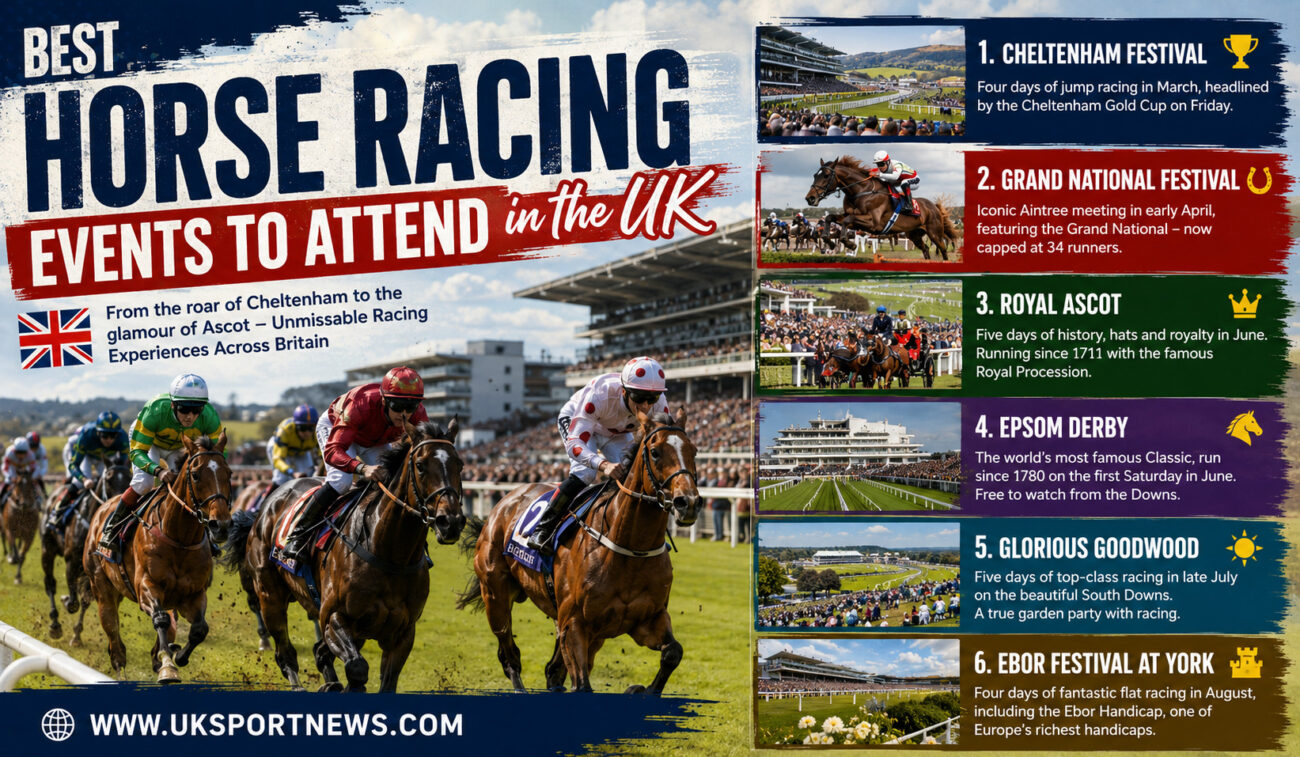
- Cheltenham Festival: Four days in March, headlined by the Gold Cup on Friday.
- Grand National Festival: Early April at Aintree, now capped at 34 runners.
- Royal Ascot: Five days in June, running since 1711.
- Epsom Derby: First Saturday in June, run since 1780.
- Glorious Goodwood: Five days in late July on the South Downs, since 1802.
- Ebor Festival: Four days in August at York, since 1843.
FAQs
What is the biggest horse racing event in the UK?
The Grand National draws the largest television audience, while Royal Ascot and the Cheltenham Festival draw the biggest in-person crowds across their multi-day meetings.
When is the best time of year to attend UK horse racing events?
The main season runs from March, with Cheltenham, through August, with the Ebor Festival, though flat racing continues into the autumn.
Do I need a formal dress code to attend?
Royal Ascot’s Royal Enclosure has a strict dress code, but most enclosures at most meetings, including Cheltenham and the Grand National, are far more relaxed.
Can I watch the Epsom Derby for free?
Yes, the Downs area at Epsom is free to access and offers a view of the course without a grandstand ticket.
Which event is most family-friendly?
Glorious Goodwood and the Ebor Festival tend to have a more relaxed, day-out atmosphere than the more formal Royal Ascot.
Conclusion
Whichever horse racing events in the UK you choose, from Cheltenham’s roar in March to Goodwood’s South Downs views in July, each one brings its own history and its own kind of day out. Pick a race that matches the atmosphere you want, and book early.
