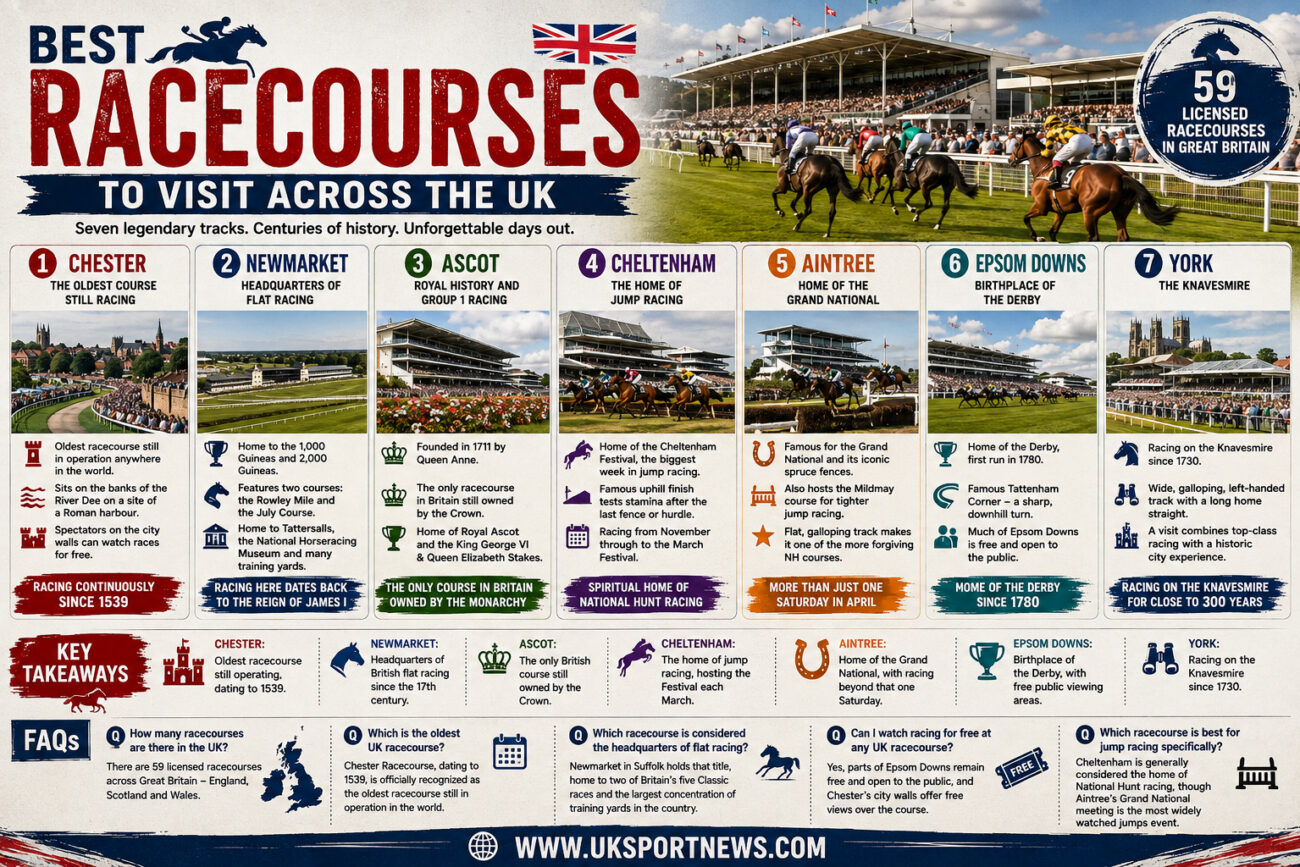
There are 59 licensed racecourses in Great Britain, and no two ride the same. A horse that wins easily on Chester’s tight mile-long loop might struggle entirely on Newmarket’s wide-open Rowley Mile. If you’re choosing among UK racecourses for your next day out, the track itself, not just the race card, is worth thinking about. Here are the ones that stand out.
Chester: The Oldest Course Still Racing
Chester Racecourse, known locally as the Roodee, has been hosting races since 1539, making it the oldest racecourse still in operation anywhere in the world, a title recognized by Guinness World Records. It sits on the banks of the River Dee on the site of what was once a Roman harbour, and at just over a mile in circumference, it’s also one of the smallest significant courses in England.
Its bowl-shaped layout means spectators on Chester’s ancient city walls can watch races for free, a tradition that’s been going on for centuries.
Chester has been staging horse racing continuously since 1539.
Newmarket: The Headquarters of Flat Racing
Newmarket in Suffolk is widely known as the headquarters of British flat racing, and it earns the title. Racing there dates back to the reign of James I, and King Charles II became the only reigning monarch to ride a winning horse there, in 1671.
The town hosts two of the sport’s five British Classics, the 1,000 Guineas and 2,000 Guineas, across its two courses: the Rowley Mile, used in spring and autumn, and the July Course, used in summer. Newmarket is also home to Tattersalls, the National Horseracing Museum, and the largest cluster of training yards in the country.
Ascot: Royal History and Group 1 Racing
Ascot Racecourse in Berkshire was founded in 1711 by Queen Anne, who spotted the site while out riding from Windsor Castle. It remains the only British racecourse still owned by the Crown.
Beyond Royal Ascot in June, the course hosts racing throughout the year, including the King George VI and Queen Elizabeth Stakes in July, one of the most prestigious middle-distance races in Europe. The Royal Enclosure and its formal dress code give the course a distinct character even outside the main royal meeting.
Ascot is the only racecourse in Britain still owned by the monarchy.
Cheltenham: The Home of Jump Racing
Cheltenham Racecourse at Prestbury Park in Gloucestershire is the spiritual home of National Hunt racing in Britain. Its Cheltenham Festival, held every March, is the biggest week in jump racing, but the course hosts meetings across the entire jumps season, from November through to that March showpiece.
The course’s famous uphill finish, the final stretch runners face after the last fence or hurdle, has decided countless close races and is part of what makes Cheltenham such a demanding test of stamina.
Aintree: Home of the Grand National
Aintree Racecourse near Liverpool is best known for one race, but it’s worth visiting for more than that single Saturday in April. The course also stages the Mildmay course for tighter National Hunt racing and hosts meetings like the Becher Chase in December, run partly over modified versions of the National fences.
Aintree’s Grand National course is famous for its spruce fences, including Becher’s Brook and The Chair, and the track’s flat, galloping profile makes it one of the more forgiving surfaces for National Hunt racing in the country.
Epsom Downs: Birthplace of the Derby
Epsom Downs in Surrey has hosted racing since at least 1661, and it’s home to the Derby, first run in 1780 and now the namesake for more than 140 races worldwide, including the Kentucky Derby. The course’s defining feature is Tattenham Corner, a sharp, downhill turn into the home straight that tests balance as much as speed.
Unusually for a major British course, much of Epsom Downs remains free and open to the public, so you can watch Derby Day without buying a grandstand ticket.
York: The Knavesmire
York Racecourse sits on the Knavesmire, a stretch of common land just south of the city, and has hosted racing there since 1730. Its wide, galloping, left-handed track and long home straight make it a favorite among jockeys and trainers, and it’s regularly rated as one of the best-viewing courses in the country.
The Knavesmire has hosted racing at York for close to 300 years.
Beyond the racing, the course’s location means a visit doubles easily as a trip to one of England’s most historic cities.
Key Takeaways
- Chester: Oldest racecourse still operating, dating to 1539.
- Newmarket: Headquarters of British flat racing since the 17th century.
- Ascot: The only British course still owned by the Crown.
- Cheltenham: The spiritual home of jump racing, hosting the Festival each March.
- Aintree: Home of the Grand National, with racing beyond that one Saturday.
- Epsom Downs: Birthplace of the Derby, with free public viewing areas.
- York: Racing on the Knavesmire since 1730.
FAQs
How many racecourses are there in the UK?
There are 59 licensed racecourses across Great Britain, spread through England, Scotland, and Wales.
Which is the oldest UK racecourse?
Chester Racecourse, dating to 1539, is officially recognized as the oldest racecourse still in operation in the world.
Which racecourse is considered the headquarters of flat racing?
Newmarket in Suffolk holds that title, home to two of Britain’s five Classic races and the largest concentration of training yards in the country.
Can I watch racing for free at any UK racecourse?
Yes, parts of Epsom Downs remain free and open to the public, and Chester’s city walls offer free views over the course.
Which racecourse is best for jump racing specifically?
Cheltenham is generally considered the home of National Hunt racing, though Aintree’s Grand National meeting is the most widely watched jumps event.
Conclusion
Choosing among UK racecourses comes down to what you want from the day, whether that’s Chester’s centuries-old charm, Newmarket’s status as the sport’s headquarters, or the Downs at Epsom on Derby Day. Each track brings its own history to the racing, and that history is often as interesting as the results.
