
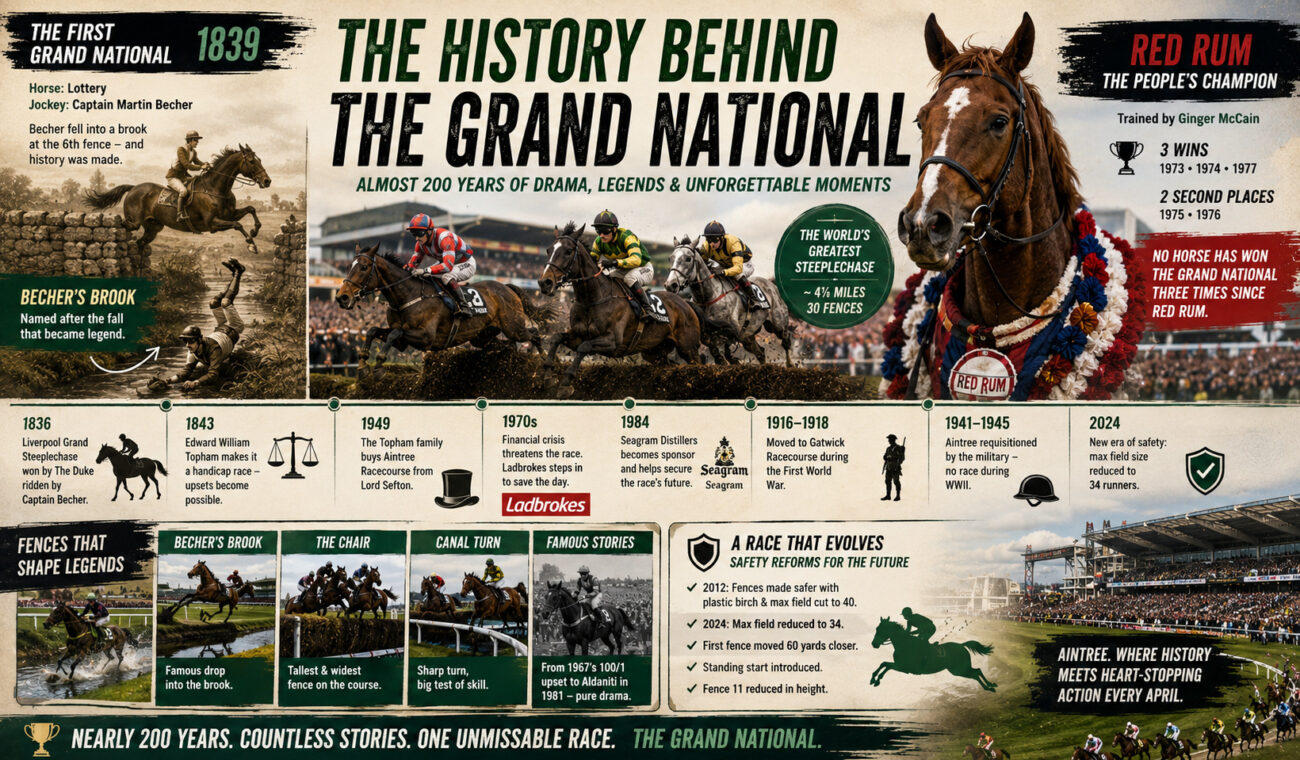
In 1839, a horse called Lottery won a steeplechase at Aintree over fences made of stone walls and ploughed land, and a jockey named Captain Martin Becher ended up in a brook after his horse dumped him at the sixth fence. Nearly two centuries later, that fence still carries his name. The history of the Grand National is full of moments like that: strange, dramatic, and stubbornly hard to forget.
Steeplechasing Before the National
Racing over jumps at Aintree started before the National did. The first recorded race there, the Liverpool Grand Steeplechase, was held in 1836 and won by a horse called The Duke, ridden by none other than Captain Becher himself.
By 1839, the race had grown into something closer to what we’d recognize today, with stone walls, ploughed fields, and hurdles standing in for the modern fences. That 1839 running is generally treated as the first official Grand National, and it’s the one Becher fell in.
Becher’s Brook, the race’s most famous fence, is named after a jockey who fell into it.
The Handicap Era and the Topham Family
In 1843, Edward William Topham reshaped the race into a handicap, meaning horses carried different weights based on ability rather than racing at level weights. That change made the field more competitive and helped cement the National’s reputation for producing genuine upsets.
The Topham family’s connection to Aintree deepened over the following century, and they bought the racecourse outright from Lord Sefton in 1949. The relationship wasn’t always smooth. By the 1970s, financial pressure had put the National’s future at Aintree in real doubt, and the course briefly faced being sold to a property developer before Ladbrokes stepped in to manage the race and secure its survival.
Red Rum: The Horse Who Saved It
If any single horse is credited with keeping the Grand National alive in the public imagination during that shaky period, it’s Red Rum. Trained by Ginger McCain, he won the race three times, in 1973, 1974, and 1977, and finished second in the two years in between, an unmatched run of five straight top-two finishes.
His first win in 1973 is remembered as much for the horse he beat as the horse who won it. Crisp, an Australian jumper, led by 33 lengths at one stage before tiring in the closing stages, allowing Red Rum to catch him right at the line.
No horse has won the Grand National three times since Red Rum did it in 1977.
The Race’s Most Famous Fences and Stories
The National is run over roughly four and a quarter miles and 30 fences across two circuits, and several of those fences have earned reputations of their own. Becher’s Brook has a steep drop on the landing side. The Chair is the tallest and widest fence on the course. The Canal Turn demands a sharp change of direction mid-jump.
The race has produced stories that go well beyond who won. In 1967, a loose horse called Foinavon caused chaos at a small fence that most of the field avoided entirely, letting a rank outsider of the same name come through to win at 100/1. In 1981, Aldaniti’s victory with jockey Bob Champion, who had recently recovered from cancer, became one of racing’s most emotional moments and was later made into a film.
A Race Interrupted by War and Uncertainty
The National hasn’t run continuously. During the First World War, it moved temporarily to Gatwick Racecourse between 1916 and 1918, while Aintree itself was requisitioned by the military during the Second World War, from 1941 to 1945.
The financial uncertainty of the 1970s and 1980s was arguably as serious a threat to the race’s survival as either war. It took commercial sponsorship, first from Ladbrokes and later Seagram Distillers from 1984, to stabilize the event before the Jockey Club eventually took over ownership and running of the course.
Safety Reforms and a Changing Race
The modern Grand National looks quite different from the one Red Rum ran. Following a 2012 renewal in which two horses died, officials replaced the timber cores in the fences with more forgiving plastic birch, aiming to reduce the rotational falls that caused serious injuries. The maximum field was cut from 50 to 40 that same year.
More recent changes followed a review after the 2023 race. From 2024, the maximum field size dropped again, from 40 to 34 runners, the first fence moved 60 yards closer to the start to slow the opening stages, and horses now begin from a standing start rather than walking to the tape. The height of the eleventh fence, which had an unusually high fall rate, was also reduced.
Key Takeaways
- First official race: 1839, won by Lottery.
- Most famous fence: Becher’s Brook, named after Captain Martin Becher’s fall in 1839.
- Most successful horse: Red Rum, three wins between 1973 and 1977.
- Wartime disruption: Moved to Gatwick (1916-18) and suspended during WWII (1941-45).
- Recent safety change: Field size cut to a maximum of 34 runners from 2024.
FAQs
When was the first Grand National run?
The first officially recorded Grand National took place in 1839, though a related steeplechase was run at Aintree as early as 1836.
Why is Becher’s Brook so famous?
It’s named after Captain Martin Becher, who fell into the brook there during the first official race in 1839.
Which horse has won the Grand National the most times?
Red Rum, who won three times between 1973 and 1977 and finished second twice in that same stretch.
Has the Grand National ever been cancelled or moved?
Yes, it moved to Gatwick Racecourse during the First World War and was suspended entirely during the Second World War.
How has the race changed in recent years?
Recent safety reforms have reduced the maximum field to 34 runners, moved the first fence, and introduced a standing start, among other changes.
Conclusion
The history of the Grand National is a mix of triumph, tragedy, and constant change, from Becher’s fall in a brook to Red Rum’s three wins to the safety reforms still reshaping the race today. Almost 200 years on, it remains one of the few sporting events that can stop the country for an afternoon.
This article discusses horse fatalities at the Grand National in the context of safety reforms. If aspects of animal welfare in racing are a concern for you, organizations like World Horse Welfare and the RSPCA publish detailed information on the subject.
